
Showing posts with label PEI Schools. Show all posts
Showing posts with label PEI Schools. Show all posts
Thursday, February 12, 2015

Wednesday, February 11, 2015

Tuesday, September 27, 2011
Union Corner Schoolhouse Museum No. 58
Just up the road from the Union Corner United Church, on Rte. 11 is the Union Corner Schoolhouse Museum - it's close to the shore and not far from the Union Corner Provincial Park.


At the corner, the old schoolhouse has been turned into the Union Corner Schoolhouse Museum. It is said to be named Union Corner because the school was built with the goodwill of everyone. cf. http://www.peisland.com/virtualtour6/v-tour71.htm#26.3km

See the following website for interior photos:


Below: The double outhouse behind the school.

Friday, September 23, 2011
Cascumpec School
I was to western PEI yesterday afternoon to a meeting in Alberton - I took Route 12 in from the Western Road and on my way took a minute to take a few photographs of this old schoolhouse. There are 4 sets of paired 4-over-4 windows on the southwest wall and a 2-over-4 window in the attic on front. The school closed in 1978.
 Thomas Key is on record as the first teacher of the Cascumpec School when it opened in 1862 followed by a list of 62 teachers. On the occasion he was commended for his good work by the "School Visitor". His proficiency and success in instructing local scholars in Arithmetic, Writing, Reading & Elocution did not go unnoticed. ( c.f. http://www.islandregister.com/key1.html )


Thursday, September 22, 2011
St. Catherine's School
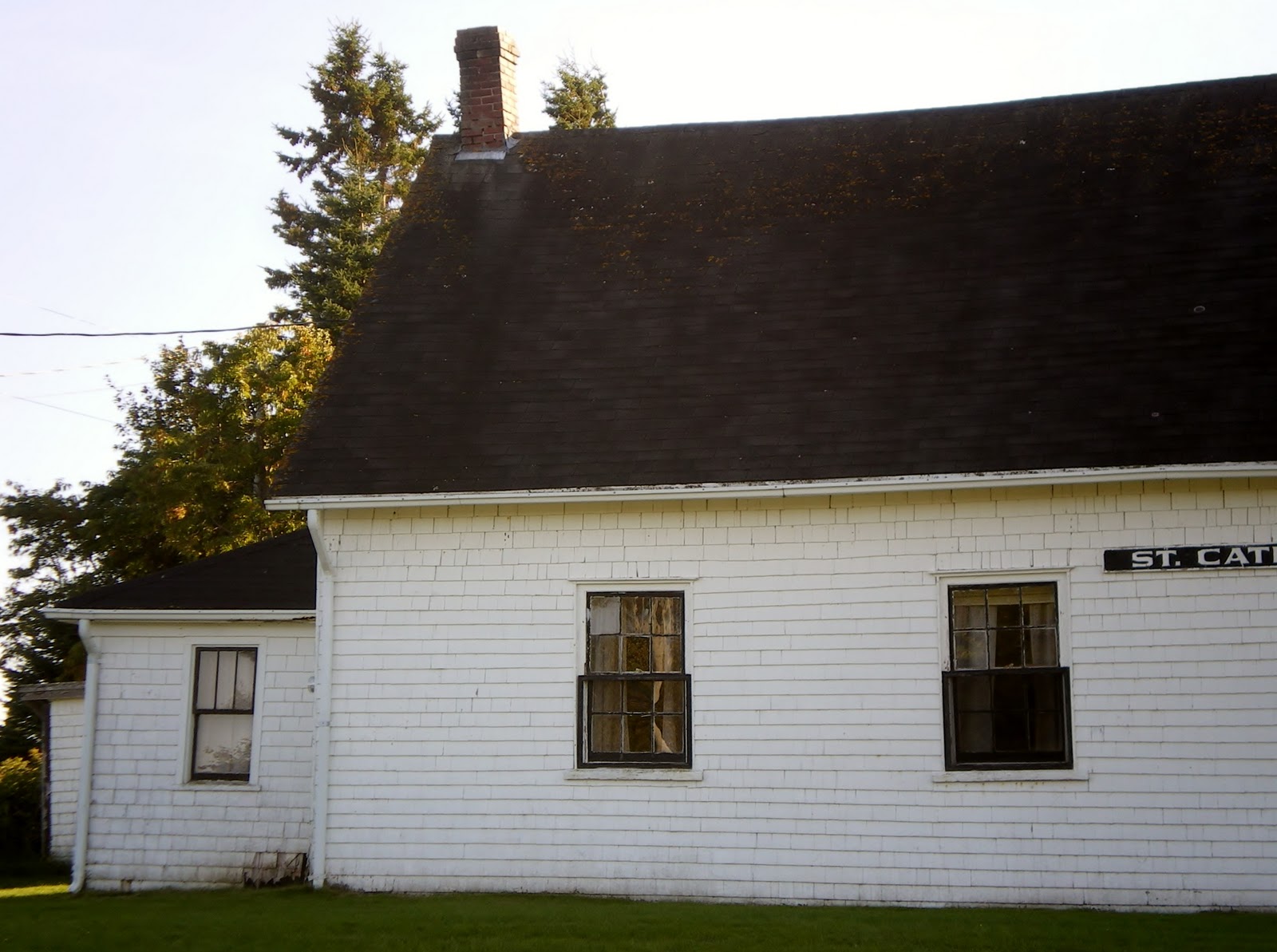
I was out to the rolling hills of St. Catherine's (9 miles SW of Charlottetown - there's another St. Catherines up near Souris) late yesterday afternoon - here's the old schoolhouse located on the corner of St. Catherine's Road and Stutvoet Drive.

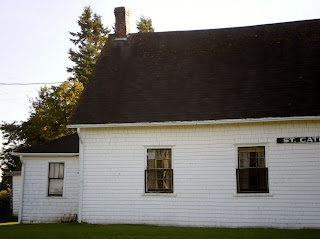


There's been a school here since 1865 (cf. Geographical Place Names of PEI). The building could be from this period as the roof pitch and narrow trim around the door and 6-over-6 window next to it are typical of the period.


Saturday, August 13, 2011
Little Pierre Jacques School / Milburn 1881
When i was in the Alaska Schoolhouse I photographed the following document posted on the wall. Today we know this community as Milburn and is located on the Little Pierre Jacques River.


The following is a transcription of the above:
Agreement made this twelvth day of April one thousand eight hundred and eighty one. between George Boulter of the one part and the Trustees of School District No. 105 in the County of Prince Commonly known as the Little Pierre Jacques School District of the other part.
George Boulter hereby agrees to built a school house according to plans and specifications to be finished by the fifteen of November 1881 And the Trustees do agree to pay George Boulter the sum of eighty dollars on the first of July 1881. Providing the building is boarded and shingled by that time. And the remaining sum of one hundred and thirty four dollars and ninty cents on the fifteenth of November 1881.
In testamony whereby the said parties have hereunto set this their seals.
12 April 1881 George Boulter
Trustees: John McDonald, John Boulter, Benj L. Campbell
Whereas the said George Boulter has taken the Contract of building the Little Pierre Jacques Schoolhouse.
___________________________________
Many communities in this area had their original names changed, ie: Coleman (formerly Brae Station), Hebron (formerly Indian Point), and Glenwood (formerly Pierre Jacques).Friday, August 12, 2011
Alaska (P.E.I.) Schoolhouse
Did you know there was a community on Prince Edward Island called Alaska? It's located in western PEI not far from the Brae, close to Coleman, near O'Leary. Behind the PEI Potato Museum in O'Leary is a park with four historic buildings which belong to the museum complex. The Alaska Schoolhouse was moved here a few years ago and is open to the public as a museum. Here's photos from my visit last Sunday afternoon.


 Below: the chalk board is made of two very wide boards.
 Below: the chalk shelf detailing.


Below: the door into the porch is a 5-board door with latch - probably not the original door.

Below: as you walk into the porch there's a bell - not sure of the story behind it.

Below: the view as you walk in to the 1-room schoolhouse - there's no raised platform for the teachers desk in this school.


Below: The back wall of the schoolroom - looking into the porch.

Below: my father, Wilbert C. Jeffery, recalling his school days at Lauretta and Alma schools. Dad's 81 years old - his teacher in Alma school (c. 1939) is still alive, her name is Vera (Rennie) MacNeill of Elmsdale (formerly of Alma) - she's 97 or 98 and doing well! Vera taught my youngest brother Kenny in Alberton Elementary in 1979-80.

Tuesday, August 2, 2011
Fanning School, Malpeque
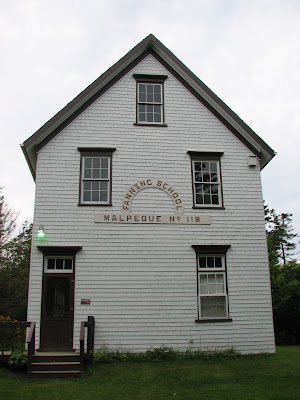
I was out by Malpeque on the weekend and visited the Fanning School. The school was built in 1794 and used until 1969 - it was moved to Cabot Beach Provincial Park and restored in 1993. Upon entry you are greeted by two students who operate a type of day-program in the old schoolhouse - there's a table game, kids books, etc. They also sell ice cream - $1 per scoop. The second floor is set-up museum style.
My blog friend Mark, who has much knowledge of Maritime and Canadian Historic buildings, believes this school could be the oldest frame schoolhouse in Canada. The school is not on the Canadian Registry of Historic Places.
Here's some information I was able to find about the school and photos taken during my visit.
 Below: the East elevation of Fanning School - appears as though there was once a door on the right side of the main floor. The exterior door to the left is the main door and as you walk in the stairs up is there.


 Below: Here's the corner where the Fanning School stood before being moved out to Cabot Park.


My blog friend Mark, who has much knowledge of Maritime and Canadian Historic buildings, believes this school could be the oldest frame schoolhouse in Canada. The school is not on the Canadian Registry of Historic Places.
Here's some information I was able to find about the school and photos taken during my visit.
-----------------------------------
The following comes from: http://www.kennet.pe.ca/chip/gallery/fanning.htm
The Fanning school. Edmund Fanning, the Lt. Governor of Prince Edward Island in the 1790s, often made summer visits to the Malpeque area and was interested in the advancement of education on the Island. Because of Edmund Fanning's stature and interest, the new school opened in Malpeque in 1794 was named in honor of him. As early as 1815, newspaper reports indicate that children from Charlottetown were being sent to the area to attend the Fanning School. (Garnett Turner)
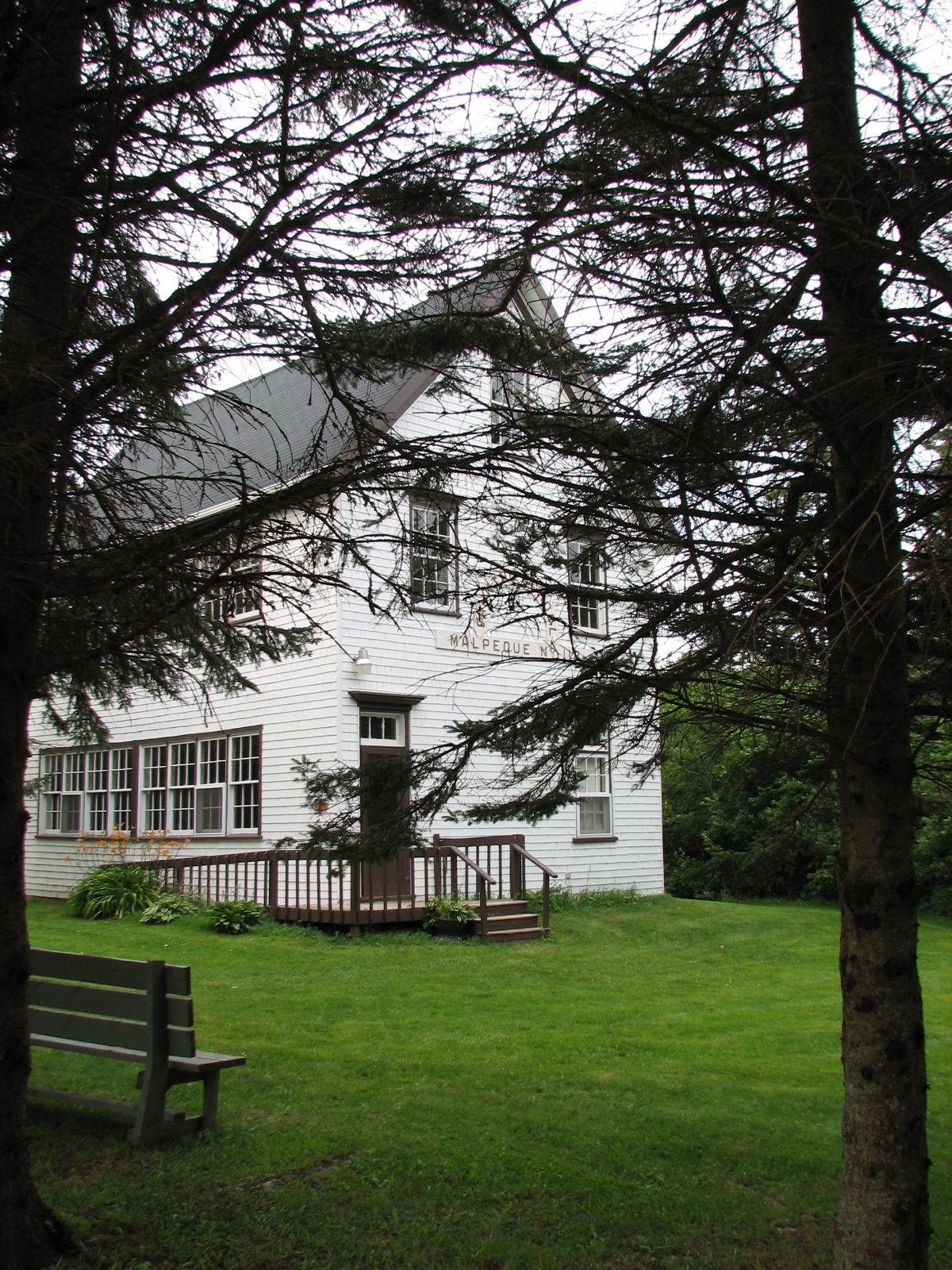

Below: the South side of the Fanning School.

Below: There are no windows on the north and west walls of the school.

Below: Rounded corners of Fanning School - all the corners are like this.
Below: A painting of Fanning School, not signed.

Below: Fanning School was on the corner of King St. and Princetown Rd.


Here's some more information about the school from:
There has been a Fanning school in Malpeque since 1794. The residents of Malpeque started to build a framed schoolhouse when the log schoolhouse which John Craig from Scotland built in 1771, proved inadequate. The people named the school "Fanning" in honor of Edmund Fanning, the Lt. Governor of Prince Edward Island from 1787 to 1805. He spent his summers with Donald Montgomery at Fox Point, Malpeque, and was interested in the advancement of education.
In 1815, the "Presbyterian", a newspaper of Charlottetown, reported children from as far away as Charlottetown were sent to attend Fanning School.
The school acquired an excellent reputation from the beginning. Much of the fame was due to the leadership provided by Rev. John Keir of Malpeque. In 1822 Rev. John Keir drew up rules and regulations governing Fanning school, and appointed a board of trustees, to be elected annually.
Legislation passed rules and laws for the Prince Edward Island schools in 1825 and named this school "Fanning Grammar School". Two other Grammar Schools and a Board of Education were established in 1830 and an Act was passed in 1837 for the Government inspection of schools.
Maria M. Fanning donated two eight acre lots to the school trustees in 1850 for a school master's residence.
There was uniformity of test books for the first time in Island schools in 1876. This was the year the upper classroom was added in the "Institute" (Malpeque Hall) during the restoration period.
Another daughter, Lady Cumberland, proved to be a philanthropist. She sent from England 450 pounds Stirling to be invested by special "Cumberland Trustees" to provide interest to be awarded to pupils of Fanning School as a special Scholarship and prizes. She also leased a piece of land in Charlottetown to the Gas Company, now Maritime Electric, in 1884 and the rent from this land was to go to the Cumberland Trustees. The first prizes were awarded in March 1885. Records of the Scholarship winners have been kept since 1891 to the present day. They are still awarded to Malpeque students.
In the history of Fanning School one of the most illustrious teachers was Sir Andrew MacPhail. In a letter to his friend Tom MacNutt, he wrote about his experiences in Malpeque. One experience he enjoyed was meeting a flow of visitors from Harvard and other American Universities during the summer. They would visit Fanning School and incite scholars and teachers alike to greater effort. They looked upon the teachers as friends.
In 1888 reports stated Fanning School was the only school that was endowed. In 1961 Grades 7-10 went to Kensington High School. In 1969 Grades 1-6 went to the Indian River School and Fanning School was closed. 1976 saw consolidation for all schools in the area. Grades 1-6 went to Queen Elizabeth Elementary in Kensington.
The Women's Institute of Malpeque bought the school from the Government, hoping to restore and keep it as a testimonial of all it stood for through the years. As time passed, it was not feasible to keep up both the school and the community hall. In 1976, the building and lot were sold to Mr. Sharp of Toronto, an artist/photographer, but ill health forced Mr. Sharp to sell it again.
The building and lot were sold to Valerie Ellwood of Kent, England. After a few years of bad luck she was unable to maintain the building and Mrs. Ellwood was informed the building would be demolished if she didn't do something. With a deep love for the old Fanning School Mrs. Ellwood appealed to the Community of Malpeque for help to save it. A group of people influenced by Bill Auld, a descendant of Rev. John Keir, organized under the name "Save Fanning School Inc." to assist in this appeal. They made an agreement with the Provincial Government of PEI to lease a piece of land in Cabot Beach Park for the school. In March of 1993 the school was moved to this its present location at Cabot Provincial Park, Malpeque.
The next phase for the much loved Fanning School saw a new influx of visitors to its doors as it was used in the series "Emily", a Cinar/Salter Street Television Series. The 13 one-hour episodes, based on the Emily books by Island author Lucy Maud Montgomery, began production in September /96.
Marlene Matthews, Advertising Producer, said "I found an unexpected set already constructed and waiting for me at Cabot Park". "It's authentic and will be used as the school house that Emily will go to".
Today, visitors can see the school as it once was, and children can use the rooms to play summer indoor games and activities when visiting the park.
In 1815, the "Presbyterian", a newspaper of Charlottetown, reported children from as far away as Charlottetown were sent to attend Fanning School.
The school acquired an excellent reputation from the beginning. Much of the fame was due to the leadership provided by Rev. John Keir of Malpeque. In 1822 Rev. John Keir drew up rules and regulations governing Fanning school, and appointed a board of trustees, to be elected annually.
Legislation passed rules and laws for the Prince Edward Island schools in 1825 and named this school "Fanning Grammar School". Two other Grammar Schools and a Board of Education were established in 1830 and an Act was passed in 1837 for the Government inspection of schools.
Maria M. Fanning donated two eight acre lots to the school trustees in 1850 for a school master's residence.
There was uniformity of test books for the first time in Island schools in 1876. This was the year the upper classroom was added in the "Institute" (Malpeque Hall) during the restoration period.
Another daughter, Lady Cumberland, proved to be a philanthropist. She sent from England 450 pounds Stirling to be invested by special "Cumberland Trustees" to provide interest to be awarded to pupils of Fanning School as a special Scholarship and prizes. She also leased a piece of land in Charlottetown to the Gas Company, now Maritime Electric, in 1884 and the rent from this land was to go to the Cumberland Trustees. The first prizes were awarded in March 1885. Records of the Scholarship winners have been kept since 1891 to the present day. They are still awarded to Malpeque students.
In the history of Fanning School one of the most illustrious teachers was Sir Andrew MacPhail. In a letter to his friend Tom MacNutt, he wrote about his experiences in Malpeque. One experience he enjoyed was meeting a flow of visitors from Harvard and other American Universities during the summer. They would visit Fanning School and incite scholars and teachers alike to greater effort. They looked upon the teachers as friends.
In 1888 reports stated Fanning School was the only school that was endowed. In 1961 Grades 7-10 went to Kensington High School. In 1969 Grades 1-6 went to the Indian River School and Fanning School was closed. 1976 saw consolidation for all schools in the area. Grades 1-6 went to Queen Elizabeth Elementary in Kensington.
The Women's Institute of Malpeque bought the school from the Government, hoping to restore and keep it as a testimonial of all it stood for through the years. As time passed, it was not feasible to keep up both the school and the community hall. In 1976, the building and lot were sold to Mr. Sharp of Toronto, an artist/photographer, but ill health forced Mr. Sharp to sell it again.
The building and lot were sold to Valerie Ellwood of Kent, England. After a few years of bad luck she was unable to maintain the building and Mrs. Ellwood was informed the building would be demolished if she didn't do something. With a deep love for the old Fanning School Mrs. Ellwood appealed to the Community of Malpeque for help to save it. A group of people influenced by Bill Auld, a descendant of Rev. John Keir, organized under the name "Save Fanning School Inc." to assist in this appeal. They made an agreement with the Provincial Government of PEI to lease a piece of land in Cabot Beach Park for the school. In March of 1993 the school was moved to this its present location at Cabot Provincial Park, Malpeque.
The next phase for the much loved Fanning School saw a new influx of visitors to its doors as it was used in the series "Emily", a Cinar/Salter Street Television Series. The 13 one-hour episodes, based on the Emily books by Island author Lucy Maud Montgomery, began production in September /96.
Marlene Matthews, Advertising Producer, said "I found an unexpected set already constructed and waiting for me at Cabot Park". "It's authentic and will be used as the school house that Emily will go to".
Today, visitors can see the school as it once was, and children can use the rooms to play summer indoor games and activities when visiting the park.
Below: the Second Floor Classroom.

Below: the teacher's desk/table is on a raised platform/ stage.

Below: the blackboard is made of 4 wooden boards - amazing!

Below: a close-up of the blackboard - you can see the seams and nails.

Below: the other end of the second floor classroom. The door to the left takes you to the stairs down - the door to the right was locked - probably a storage room.

Below: in the upper middle of the wall (of the photo above) is a small door accessing the attic - you can see the gable window beyond and can see where the chimney was originally located.

Below: the locked storage room door.

Below: looking into the stairwell. The main floor schoolroom is on the right at the bottom of the stairs.

Below: a close-up look at the steps and detailing.

Below: typical school desks - the ones on the right are smaller than the others.

Below: a cabinet full of books - see below the name of the school carved into the top detailing.


Below: Teachers of Malpeque Schools 1834-1934.

Subscribe to:
Posts (Atom)