Showing posts with label Coleman. Show all posts

Tuesday, December 6, 2016

Leard's 1888 Grist Mill receives more money!

     Now for the good news today!  I was informed this afternoon that another anonymous donation of $20,000 is being made to our campaign to save the last fully-intact grist mill on Prince Edward Island!  Great things are happening with this project!
     Below is a recent painting of Leard's Grist Mill by Mary E. MacDonald of O'Leary.

Sunday, October 4, 2015

Leard's Mill Fundraising - help save the last grist mill on PEI!

     LEARDS MILL HATS AND T-SHIRTS FOR SALE, HELP SAVE LEARDS MILL WITH EACH PURCHASE.  $10 for Hats and $13 for T-shirts.  Now available at the Canadian Potato Museum, O’Leary, Prince Edward Island.  Phone: (902) 859-2039.
* * * * * * * * * * * * * * * * * * * * * *
     JoDee Samuelson (Old Mills of PEI Map, 1996) has calculated = in 1871 there were 117 grist mills on Prince Edward Island - 27 west of Summerside!  Today we have one (1) left on the whole Island, Leard's Mill, and it needs to be saved!!!!
Above: 1888 Leard's Mill, southwest view from the Buchanan Road, Coleman.
I took these photos in the fall of 2014.
Above: west view of Leard's Mill from the Confederation Trail.
 Above info cf. A Light in the Field by H.M. Scott Smith's book, Mills,of PEI.
Above page cf. Past & Present: A History of Brae.  Page 149.
Above: JoDee Samuelson's, Old Mills of Prince Edward Island Map, 1996.

Saturday, June 20, 2015

Historic 1888 Leard's Mill threat to fish

     It's amazing the slant we have to resort to to these days to save heritage buildings, ie: the immensely important Leard's  Grist Mill in Coleman.  It's a threat to fish?!   We can't use the argument that it's one of the last intact grist mills left on the Island (from inventory of over 340); or that it's one of three or four grist mills left in the Maritime Provinces?
     Thank you to local MLA Robbie Henderson for bringing the mill to public attention!!! With help from our Island government the folks at the Canadian Potato Museum will save this mill for generations to come.
The following cf.
HISTORIC LEARD'S MILL THREATENS P.E.I. RIVER
Rain Storms caused structural damage to heritage building.
CBC News PEI - June 19, 2015
     A historic mill in western P.E.I. is on the verge of collapsing into a river, polluting it with the potentially toxic materials used to build it.   Leard's Grist Mill in Coleman, currently owned by the P.E.I. Potato Museum, was built in 1888 and continued operating until 2002. Local MLA Robert Henderson told the legislature Thursday last fall's heavy rain storms severely damaged the building. Henderson said there is now a risk it will collapse into the river, which could be a hazard for fish populations.  He said the Potato Museum has applied twice for government funding to stabilize the structure.  "Regrettably their request was denied," he said.   "Can the minister work with his colleagues responsible for these two programmes and attain the necessary funds to avert an environmental catastrophe in the Trout River?"  Environment Minister Robert Mitchell said he wasn't aware of the Potato Museum's application, but he will do what he can to avoid any potential hazard.  "Definitely willing to commit to work with the member and any other departments that we may be able to assist with the community and with the group that own the facility, to try to help them get this building in a much-better condition where we don't have to worry about such a catastrophic event," said Mitchell.  Henderson said the Canadian Potato Museum, which is a non-profit organization, is willing to help pay for construction but cannot afford to pay for the repairs alone.

Sunday, March 29, 2015

Coleman

     A couple of Sunday's ago I picked up my 95-year-old grandmother, Empress (MacNevin) McDowell to spend the day with her.  As I made my way to O'Leary I took a different route through Coleman - here's a few photos I took with my cellphone.
     Above: an old railroad warehouse beside the Confederation Trail in Coleman.  The store to the left was owned by Rankin Wallace and later by his niece Margaret Lockhart who ran the store until the mid-1990's.
     Above: Free Church of Scotland at Coleman Corner.  Built around 1895.  This was my grandmother's family's church.  The church was used seasonally until a couple of years ago.
See previous post on this blog...
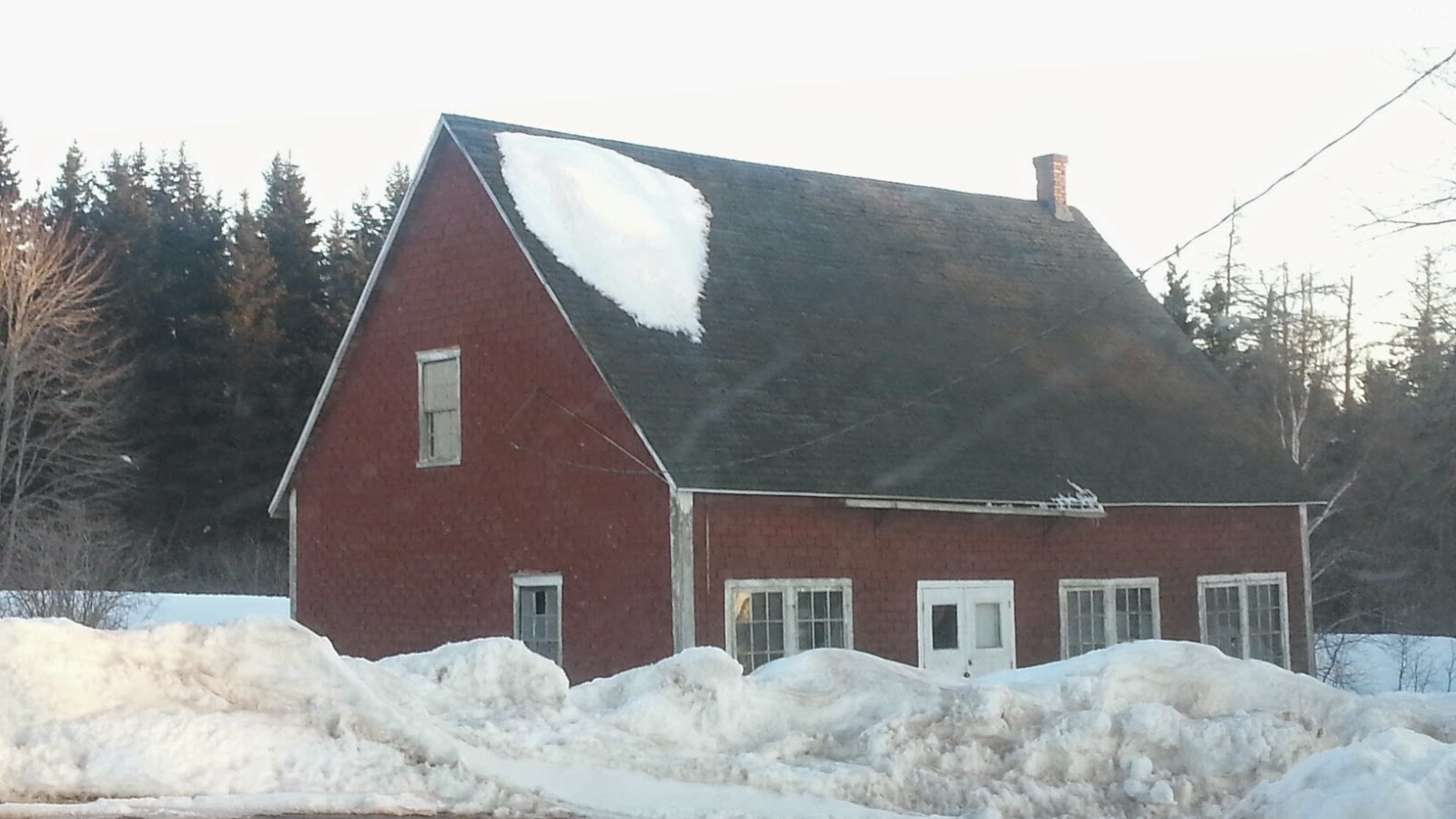
Above: a long abandoned house between the Church of Scotland and Leard's Mill.


     Above & Below: Leard's Mill, built in 1888 by James Barclay, it was later sold to Peter Warren Leard in 1899.  The mill continued operation by the Leard family until 1999.  Today the mill is owned by the Canadian Potato Museum in O'Leary.
     See previous post on this blog...
     Above:  this was the homestead of Sanford Phillips located in Mount Royal (between Coleman and O'Leary) - he was a successful farmer with a great herd of Guernsey cows.   The house was sold out of the family many years ago and following the death of that owner the house was abandoned.
Above: O'Leary United Church at the Corner of Main Street and Barclay Road.
Below are a photos I took of the church interior last winter.

Friday, December 12, 2014

Leard's Grist Mill, Coleman - storm flooding!

     These images were taken at Leard's Grist Mill and Pond yesterday morning by CBC PEI's Steve Bruce.  Photos cf. CBC PEI Facebook page.
     The structure was strongly built - I'm confident it will withstand the flood waters as it has so many times before!


     Leard's Grist Mill was built in 1888 by James Barclay of O'Leary.  In the late 1890's Peter Warren Leard purchased the mill.  Three generations of the Leard family operated the mill including Peter's sons Waldron and Albert and his grandson Warren, who closed it in 2002 after working here for more than 50 years.  
     The mill belongs to The Canadian Potato Museum in O'Leary. 
Below are a few photos I took of Leard's Grist Mill this fall.

Sunday, September 2, 2012

Free Church of Scotland, Coleman

     My grandmother Empress (MacNevin) McDowell went to this church as a child in the 1920's.  They lived in Milo, a few miles away from Coleman, so in winter they had Sunday School in Milo Hall. She recently told me this is/was a MacDonaldite Church.
Below: the church is on the corner of Rte. 14 and 140.
     The following information comes from, Past and Present: History of the Brae, 1979.  Pages 129-130.
     The one Free Church of Scotland (formerly Church of Scotland) that is situated west of Summerside was erected at Coleman by settlers of Lot 9, who, at a previous time, were part of the congregation of the Church of Scotland at DeSable.  The land in Coleman on which the church stands was purchased from Mr. John Higgins in 1895.  Members of the congregation believe the church was erected there sometime between 1895 and the turn of the century.  At a later time, the Church of Scotland in Prince Edward Island established a link with the Free Church of Scotland.  The Free Church of Scotland is Presbyterian in government and the congregations in Prince Edward Island form three pastoral charges under one Presbytery.  The church at Coleman is part of the Western Charge.  The emblem of the Free Church of Scotland is the burning bush; the spire of each church is topped with a Scottish thistle.  The minister in charge of the spiritual welfare of the Coleman congregation at the time the church was erected was Rev. Mr. Goodwill.  Other remembered ministers are Rev. Daniel MacLean, Rev. Mr. Campbell, Rev. James MacDougall, Rev. Ewan MacDougall, Rev. Harvey Bishop, Rev. David Compton.  Other ministers gave periods of supply, and in the 1950's and early 1960's, a number of ministers from Scotland gave assistance on the charge.  The minister in 1978 is Rev. John MacLeod of Scotland.  The first elders of the congregation were Dougald MacLean, Brea; Duncan MacLean, Milo; and Warren Wright, Coleman.  A pamphlet entitled Free Church of Scotland in Prince Edward Island and published by Presbytery some time since 1970 states (in part):  "The Free Church bears testimony to the Christian faith as stated in the Westminster Confession of Faith and the well known shorter catechism.  As a church she steadfastly contends for a return to this faith of our fathers which rests upon the unfallible and inerrant Scriptures of the Old and New Testaments."  
     A Church of Scotland cemetery is situated in Milo, Lot 9.
Below: I took these photos by placing the camera lens square against the window glass.

     There's still regular services held here - here's their website - http://www.peifreechurch.org/

History
Dating from 1843 but with its roots in the Reformation, The Free Church of Scotland owes its distinctive title to its historical struggle to remain free from state interference in its internal affairs. It is an Evangelical Presbyterian Church. It has close and active relations with many other Reformed churches of Jesus Christ throughout the world and stands firmly in the tradition which accepts the Bible in its entirety as the Word of God and, therefore, derive its forms of teaching, worship, ministry and government from it. The main emphasis of our worship is the preaching of the gospel — the good news of a free and sovereign salvation through Jesus Christ alone.
The Free Church has had an extensive history on Prince Edward Island with historical associations with the ministry of Rev. Donald MacDonald. An ordained minister from Perthshire, Scotland, came to the Island in 1826. He preached wherever opportunity presented itself – in private homes, barns and hillsides. The content of his messages was strongly Calvinistic. Such preaching is in great contrast to that of present day ecumenism in which the great doctrines of the Reformation – “Justification by faith alone” and “Divine Sovereignty” are obscured if not completely obliterated.
In the years since, the ministers and elders of these congregations endeavoured to uphold the everlasting gospel. However, following a series of church unions they became more or less isolated and as it was unsatisfactory to continue in such isolation eventually a link was established with the Free Church of Scotland. The church is Presbyterian in government and the congregations on Prince Edward Island, at present, form three pastoral charges united under one Presbytery. The next superior body is the Synod of North America.
At the time of Donald MacDonald’s death in 1867 the population of the church was numbered in the thousands. Shortly thereafter, Rev. Mr. James MacColl spent a brief time ministering to these people. In 1875, Rev. John Goodwill, a former missionary commenced a lengthy ministry. Although there was not entire satisfaction with his preaching at first, a widespread revival occurred in the latter part of his ministry and the church greatly strengthened. During Mr. Goodwill’s time some elders also conducted services beings set apart as preaching elders. These elders included Ewen Lamont, George Bears, Elias Roberts, and John Compton. Other early ministers were Rev. D. M. Campbell and Rev. William Campbell.
The Free Church of Scotland bears testimony to the Christian faith as stated in the Westminster Confession of Faith and the well known shorter catechism. As a church she steadfastly contends for a return to this faith of our fathers which rests upon the infallible and inerrant Scriptures of the Old and New Testaments.
“…that in all things he may have the preeminence.”   Col 1:18

Thursday, November 17, 2011

Leard's Mill, Coleman

I read in today's Journal Pioneer Newspaper that the Leards Pond has been restored - below are a few photos of the mill I took on March 1, 2003; a children school project; and the Journal Pioneer article.
The mill is located on Route 140 in Coleman at Leards Pond.  The Mill faces south.
Below: the home adjacent to the mill where Warren and Bernice Leard lived until 2009 - the property was purchased by a local couple who will be excellent custodians of this historic property.
     A few years ago there was a website by local school children who interviewed local seniors to learn and document the stories of their lives.  Below is the story of Warren Leard, owner of this mill. The website doesn't appear to be still active - the information was collected by Kera Pineau & Michael Duquette.
===========================================
Warren Leard
owner of a grist mill

     Warren Leard, born June 18, 1925 owned Leard’s Grist Mill in Coleman. He worked there most of his life since his father owned it before him. However in 1954 to 1964 he worked for CN in Summerside because it was good pay. He came back to the mill that he knew he would end up running someday.

     Warren started working at the grist mill when he was 16 years old. It was first owned by Peter Warren Leard, then passed on to Robert Waldron Leard (Warren’s father) and Albert Leard. After this it was passed on one more generation to Warren. Warren decided to become owner of the mill because he was brought up in it. Albert’s two sons, Heith and Harry, helped run the Grist Mill as well.
     The process of turning the wheat into flour would go as follows: the farmers first brought in 80-100 bushels of wheat to be weighed in. It would be dumped into something called a hopper. Below the hopper, the cleaner sieves, fans and scours the wheat. Following this, the wheat would go through another cleaner which would take out other grains, such as oats or barley. Next, the wheat would go through sets of rollers. While going through the first set of rollers the kernels of wheat would break. The second set of rollers takes out the bran which is the outer shell and continues on through the other rollers for granulation.
     Once this is completed it is carried to the top of the building by small elevators that could almost fit in your hand (refer to picture). From here it goes through the sifter which has silks and screens on it. The silk used for the sifter came from Switzerland and its cost was about $45.00 per square yard. The end product then flows back itself by gravity to its different outlets as bran, middlings, shorts and white flour and would be stored in bags or if kept for a longer period of time it had to be shifted every so often. Some of the wheat germ (cream of wheat) was used for cereals. Otherwise it was put back into the flour to add to its value. Used to help operate the mill is 1200 feet of belting.
     Warren worked at the mill approximately 8 hours a day or more depending on how much work had to be done and then the shift would change and somebody else would work at the mill. There were 2 or 3 people working at the mill and they were paid $1.00-$1.25 for an 8 hour day. The workers would have to have general knowledge of how the mill worked as well as some math skills when they calculated the weight and price of the wheat. The money received from customers was 50 cents per bushel. The season for milling started in June and July  but the wheat was actually worked beginning in August when the harvest started.
     Some of the big differences between the flour created today and the flour that was made in such a mill as Leard’s Grist Mill are that there were no additives and the wheat germ was used in the flour. Also flour was not bleached in older grist mills as it usually is today.
     We asked Warren if he had any experiences to share with us about the grist mill and he told us the following story: His father was working on a 25 horsepower motor when it blew up breaking his father’s leg. He had to stay home with a broken leg until 8 a.m the next morning when he could board the train to Summerside as there was no hospital in O’Leary at the time.
We thank Warren for his time.  By Kera Pineau & Michael Duquette.

===========================================
Leards Pond is Back
by Eric McCarthy  November 17, 2011
                    Allan MacPhee, left, president of the Leard’s Pond (Coleman) Environmental Committee and Eric Shaw, secretary of the group, check the water flow over the stop logs in the dam. After being down for 11 years, the water level in the pond was recently put up again. Landscaping and other improvements are ongoing.

COLEMAN - After being down for 11 years, the water level in Leard's Pond, Coleman, has risen again. The stop logs were put back into the dam three weeks ago. The fish ladder is operational.
     Excavation equipment dug out the main pond basin over the past four years and made it deeper than before.
     "One of the things when we re-opened here," said Eric Shaw, secretary of the Leard's Pond (Coleman) Environmental Committee, "we had to go with a different operating level, a lower operating level."
     The lower water level keeps areas upstream from being flooded.  If the water level was allowed to rise, he explained, that would result in shallow water beyond the banks that could warm up quickly with the sun's rays
     Although the water level itself is lower, the pond is narrower than before and dug deeper. The clay and silt removed from the pond's floor was piled onto the banks and leveled out the genesis of a new park.
The pond covers six to eight acres and the park will cover two.
     Trees have been planted near the water's edge and in the future park. Grade 4 students from O'Leary Elementary School had short work of planting 100 ash, birch and maple trees Wednesday. They acknowledged the trees, once they grow, will help provide shade for the pond. Landscaping and seeding will occur later, and a parking area will be developed.
     The 12-member committee which consists of Allan MacPhee, president; John Rogers, vice-president, Jim Harris as Treasurer and Shaw as the executive and members Elton Ellis, Alton Silliker, Percy MacEachern, John Buchanan, Jimmy Baglole, Doug MacLeod, Randy Bridges and Warren Leard, has been overseeing the re-creation of the pond since 2005. During that period they raised over $12,000 through various fundraising initiatives. The provincial government provided $120,000 to assist with the work.
     Fundraising activities to assist with further upgrades will continue.
              O'Leary Elementary School Grade 4 student Tyler MacLean gets assistance from classmates, from left, Hayley Somers, Karrie Lee Veniot and Myranda Clements in planting a tree along the bank of Leard's Pond in Coleman. The bank of the pond was shaped with clay and silt taken from the floor of the pond.

By Kera Pineau and Michael Duquette