Showing posts with label St. Patrick's Church. Show all posts

Tuesday, May 27, 2014

"The most beautiful church property on PEI"- Journal-Pioneer St. Patrick's Parish, Grand River celebrates 175th Anniversary

     The following article appeared in the Journal-Pioneer on May 22, 2014 -
GRAND RIVER -- A special Mass at St. Patrick’s Roman Catholic Church in Grand River this Sunday, May 25, will celebrate the church’s 175th anniversary. Bishop Richard Grecco will preside over the 2 p.m. Mass with parish priest Fr. Albin Arsenault.
 
Journal-Pioneer Staff. May 22, 2014
            Often referred to as one of the most beautiful church properties in Prince Edward Island, St. Patrick’s was built on a hill overlooking the Grand River.
            According to an article by Rev. J.B. Reilly in the Sacred Heart Messenger in December, 1947, the Grand River church has the distinction of being the first church in Canada to be dedicated to St. Patrick.
            “This honor belongs to Grand River, PEI where in 1790, a band of immigrants from the highlands of Scotland, mainly the Islands of Barra, erected a log church to accommodate 20 families, dedicated to the Apostle of Aire,” he wrote.
            While the parish dates back to the 1790s, construction of the present church was started in 1836 with the actual dedication of the church to St. Patrick occurring on March 17, 1839. In 1890, William Critchlow Harris, designed the present church, which is constructed around the original church.
            Doug MacDougall, Chair of the parish’s heritage committee, noted that while St. Patrick’s is a small parish with just over 50 families, there is a tremendous outpouring of support as the church is a focal point of the community. “There is a great sense of community and parish spirit associated with the church,” he revealed.  Since 1993, there have been ongoing projects to restore and embellish some of the historic architecture of the church. Recently, the interior was painted and hard wood floors restored in the sanctuary.
            Common surnames in the parish over the generations have included Gillis, McIntyre, McLellan, Cameron, McDonald, Brown, MacKinnon. Praught, MacDougall, Trainor and McGuire.
            Following the anniversary Mass, there will be a brief ceremony in the Pioneer Cemetery, followed by fellowship in the parish hall. Parishioners, former parishioners and all interested people are welcome.

Thursday, May 22, 2014

St. Patrick's Parish Grand River celebrates 175th Anniversary

     The photo below appears on the front page of the Journal-Pioneer newspaper today.  
     The image is timely - in three days, on Sunday May 25th, St. Patrick's Parish will celebrate the 175th Anniversary of their historic church with a Mass at 2pm.  Bishop Richard Grecco will be the Main Celebrant.
PICTURE PERFECT - In a post card-like scene, not uncommon in rural P.E.I. this time of year, Colin Millar was busy tilling land recently for Arlington Farms in Grand River overlooking the St. Patricks Church. Bryan Maynard/special to the Journal Pioneer.  
cf. Journal-Pioneer website

Monday, February 18, 2013

Third Saint-Phillippe et Saint-Jacques Church, Baie-Egmont

     I was searching for something this morning on Google and came across a website with photos from mostly around the Evangeline area of Prince Edward Island.  Below is a photo I had never seen before and am struck by how much the church resembles two other early Catholic churches on the Island - that of 1838 St. Augustine's Rustico and 1839 St. Patrick's Grand River - see below.
     Troisième église Saint-Philippe et Saint-Jacques, Baie-Egmont. Construite en 1834 alors que le père Sylvain-Éphrem Poirier desservait la paroisse en tant que missionnaire, l’église mesurait 110 par 60 pieds, le sanctuaire non compris. La sacristie mesurait 40 par 30 pieds. L’église pouvait recevoir 1000 personnes. Elle a été démolie en 1922 pour faire place à la quatrième église, qui fut démolie en 2010.
     The third St. Philippe et St. Jacques church, Baie-Egmont. Built in 1834 during the period that father Sylvain-Éphrem Poirier served as missionary, the church was 110 feet long by 60 feet wide, not including the sanctuary. The vestry measured 40 by 30 feet. This church could seat up to 1,000 people. It was demolished in 1922 to make place for the fourth church, which was demolished in 2010.
     Above information and photo cf.  http://acadien.wikia.com/wiki/Troisi%C3%A8me_%C3%A9glise_St-Philippe_et_St-Jacques_/_Third_St._Philip_et_St._Jacques_church,_Baie-Egmont
     Above:  The 1838 St. Augustine Church of Rustico is very similar in design to Saint-Phillippe et Saint-Jacques.  The main church measures 80 feet long by 50 feet wide not including the tower or vestry.  For more information see this blog http://peiheritagebuildings.blogspot.ca/2012/09/1838-st-augustine-roman-catholic-church.html
     Above:  The 1839 St. Patrick's Church of Grand River is very similar in design to Saint-Phillipe et Saint-Jacques and St. Augustine Rustico.  However, it's hard to see the similarity in this image of St. Patricks today.  The original church, built between 1836 and 1844 (consecrated in 1839) was 60 feet long by 40 feet wide.  In 1890 the church was redesigned by well-known Island Architect Wm. C. Harris.  The original plan of the church was enlarged, a new steeple was built; false butresses added and Gothic windows installed on the upper wall in the balcony.   Photos of the original church exist, however, I don't have access to them at this time.
    For more information see this blog 

Monday, February 4, 2013

Kelly - Acorn Brick House, Lake Verde

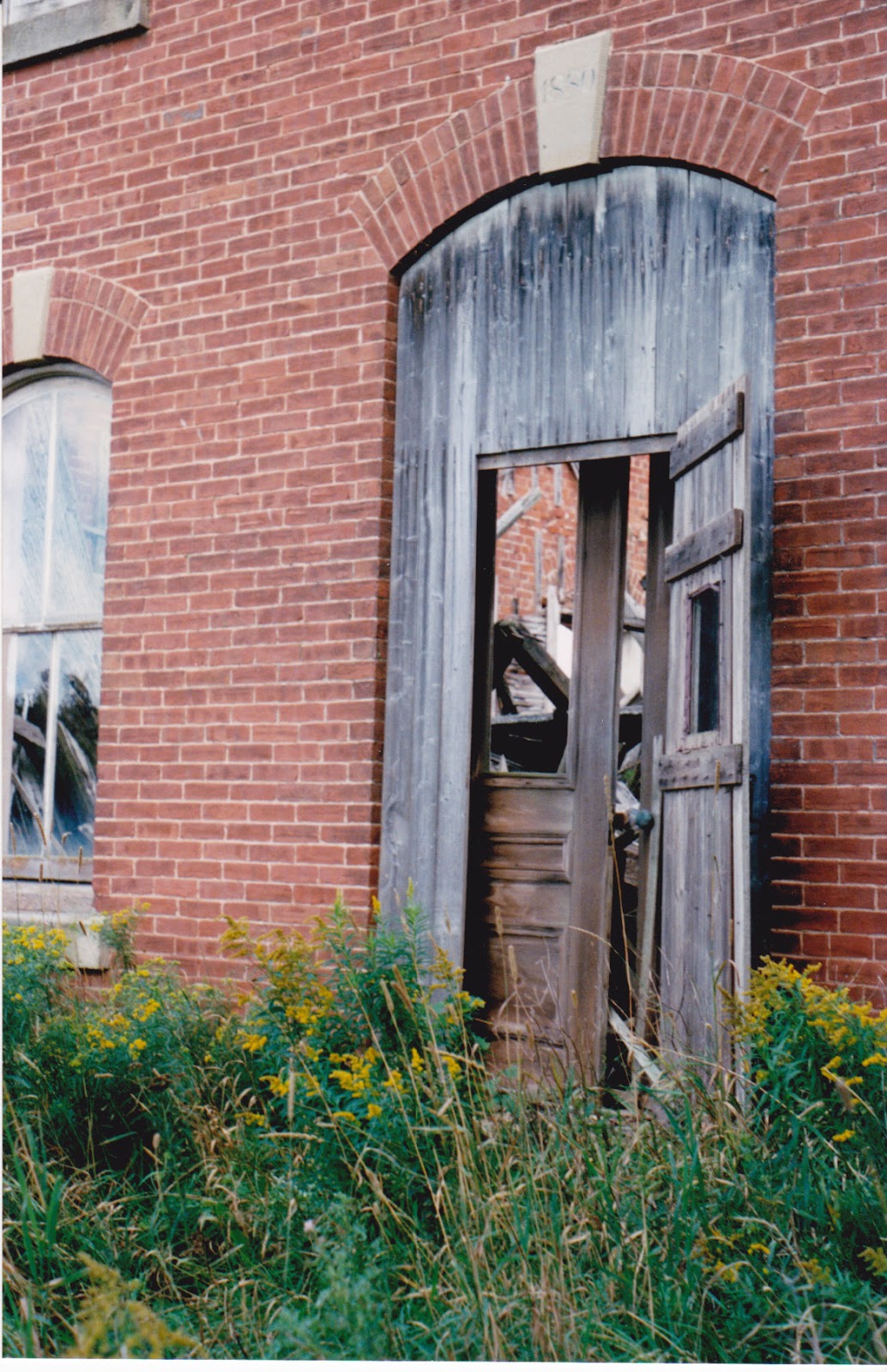
     I took the following photos of this once magnificient brick house located on the Murnaghan Road in Lake Verde, Prince Edward Island on August 26, 1988.
      The impressive brick house was built by Irish immigrant, farmer and brick-maker, Edward "Yankee Ned" Kelly.  Meacham's 1880 Atlas of Prince Edward Island (page 113) shows Edward Kelly living here on 350 acres of land - near 40% is illustrated as marshland.
     Above/Below: the front/west side of the house, facing Monoghan Rd (Rte. 213).
    The day Arnold and I were by here we noticed a fresh wood pile behind he house, it seemed like rags on the clothesline and an old tractor in the yard.  There didn't seem to be anyone around.  We looked in the windows on the main front house and walked around the to the rear - not too close to the rear kitchen wing - well enough that we didn't!!  We learned later that the two old brothers still lived here in the kitchen wing with the main part of the house in ruins.  The kitchen wing was in bad enough shape, however, it seemed weatherproof.  In talking with a local person afterwards we learned the brother were happy to live out their days there, efforts to get them in to modern accommodations were unwelcomed and they traveled by that old tractor.  It was said the house was magnificent  once upon a time and that there was a white grand piano in the parlour, and since nothing had ever been taken out of the house, it was probably still in there under the debris from the fallen floors and roof above!  A few years ago the site was demolished and cleaned up - today there's a new house there.
      The date on the key stone above the front door is "1880" - the same year it appeared in Meacham's 1880 Atlas -  see image from the Atlas below.
     A note on the Atlas image - the kitchen wing on the back had a pitched roof - often images were drawn in advance of the house/building being finished or built.  The 1880 date above the door indicates the house was built that year, the same year the atlas was published, was the house finished when the artist was by to draw the house?  Probably not.  The detailing on the kitchen wing is very elaborate - it would have matched the detailing on the main part of the house from the dormers to the brick coursing. 
     It's unusual to see such a magnificent house in the countryside - not far from here, northward, when you get to the end of the Monoghan Road, you're in Fort Augustus, on the Fort Augustus Road (Rte.21 ), and not far east is St. Patricks R.C. Church where today  still stands the large brick Parochial house built in 1875.  It looks much like the Kelly house with similar brick coursing detailing.  Below is an image of the Parochial house from Meacham's Atlas.   
     In the late 1980's the architecture firm where I was employed had the commission to transform the old brick Parochial house (which was a Sisters of St. Martha convent between 1958 and 1985) into a government agency of 4 senior's apartments.  I measured this house from basement to attic in advance of preparing our design. 
     I was back to the house in wintertime - not long after the above photos, however, I didn't date these photos.  
     As before, it was shocking to drive along the country road and see these ruins.  Walking up to the house and looking in to the main floor windows you can see the roof dormers there on the main floor.
      The last people to live in this house were brothers John and Ensley Acorn, sons of Earl E. and Lillian (MacLean) Acorn.  Cumins 1928 Atlas of Prince Edward Island shows the Acorn family living here on 175 acres and lists the property belong to Earl E. Acorn, Pownal RR#1, married to Lillian with three children: Ensley, Helen and John.  John Russell Acorn died on November 10, 2004 at the age of 82.
     The property looked like it had been devastated by a hurricane.  Note the dump cart under the tree.
   Below are references I found on Edward Kelly - sources noted.

Edward “Yankee Ned” Kelly came to PEI from County Monaghan, Ireland in 1845 with his family.  He settled first at Lake Verde where he was a farmer and brickmaker.  He later became a land developer and was very successful, hence his nickname.  Edward bought Mill Brook Farm from Major Beete in 1880.  The farm was passed to his son Joseph Kelly in 1906.  Joseph had seven daughters, and no sons, so the Kelly name continues on in the Rodgerson’s, the Rowe’s, the Hughes’, the Smallwood’s, and the McCarron’s.

[4] A newspaper of 1896 noted that "Misses Finley" had moved to a large and commodious brick building that had been known for some time as the Aberdeen House. [5] Only two years later the building, now known as Finley House was offered for sale again. Edward Kelly was listed as being the owner of the Finley House when it was offered for sale in 1904. [6] A notice appeared in the May 21 Daily Examiner of that year announcing that John T. Weeks of Alberton had recently leased the large brick house lately occupied by "Missus Finley". Weeks extensively renovated the building, renaming it the Windsor Hotel. 

Mr. Gahan lived next door to the shop, at 126 Sydney Street, in a wooden house he ahd purchased from the Brenan Estate.  In 1880 he replaced that residence with the mansard roofed brick one now at this address.  It remained in Gahan ownership until the beginning of the 20th century when John Gahan’s widow, Marguerita, sold the property to Edward Kelly, the enterprising Irishman who built and owned houses all over Charlottetown.  After Edward Kelly’s death in 1922, the premises became the property of the Roman Catholic Episcopal Corporation.
  
Mary Ann Kelly MCQUAID, birthdate unknown. Her parents were Edward KELLY, a farmer on Prince Edward Island and Anne CLARKIN (or CLERKIN) Kelly of Lot 49, Lake Verde, Monaghan (Road?),PEI. 
Meacham's Atlas of 1880 show Ann (no e?) and Edward KELLY both at lot 49. The dates next to their names are 1849 & 1845 respectively. It is our understanding that names are included in the Atlas if the individual was born in Ireland and the" date of settlement" was 1845 or earlier. 
It is uncertain whether the "date of settlement" is the date the individual arrived in PEI or the date they settled on that particular lot.
We think that Edward KELLY was born in 1837, Parish of Donaugh, Town of Killeraine, Ireland. We think that Anne Clarkin came from the town of Guilford in either Monaghan or Armaugh County, Ireland. 
We know from the Will of Edward Kelly, drawn April 7,1913 and the Codicil to that will dated October 6,1922, that Edward and Anne KELLY of Charlottetown (as of the 1913 date)had two sons and 6 daughters as follows:
1.         Joseph E.KELLY
2.         John E.KELLY
3.         Bridget KELLY (known in the religious community as Sister Joseph Mary)
4.         Mary Ann Kelly McQUAID 
5.         Theresa Kelly HUGHES
6.         Margaret KELLY (wife of a Charles KELLY) 
7.         Ellen Kelly TRAINOR (wife of Michael TRAINOR) 
8.         Catherine Kelly TRAINOR (wife of John TRAINOR) 
We know from a deed dated Jan. 3, 1905 that Edward and Anne KELLY conveyed to Mary Ann McQUAID "wife of Thomas McQUAID, Merchant" city lots 20, 29, 13 & 14 in Charlottetown.  The deed was registered April 12, 1913. Liber 63 Folio 841. Why the time difference is unknown to us.