Wednesday, August 10, 2011

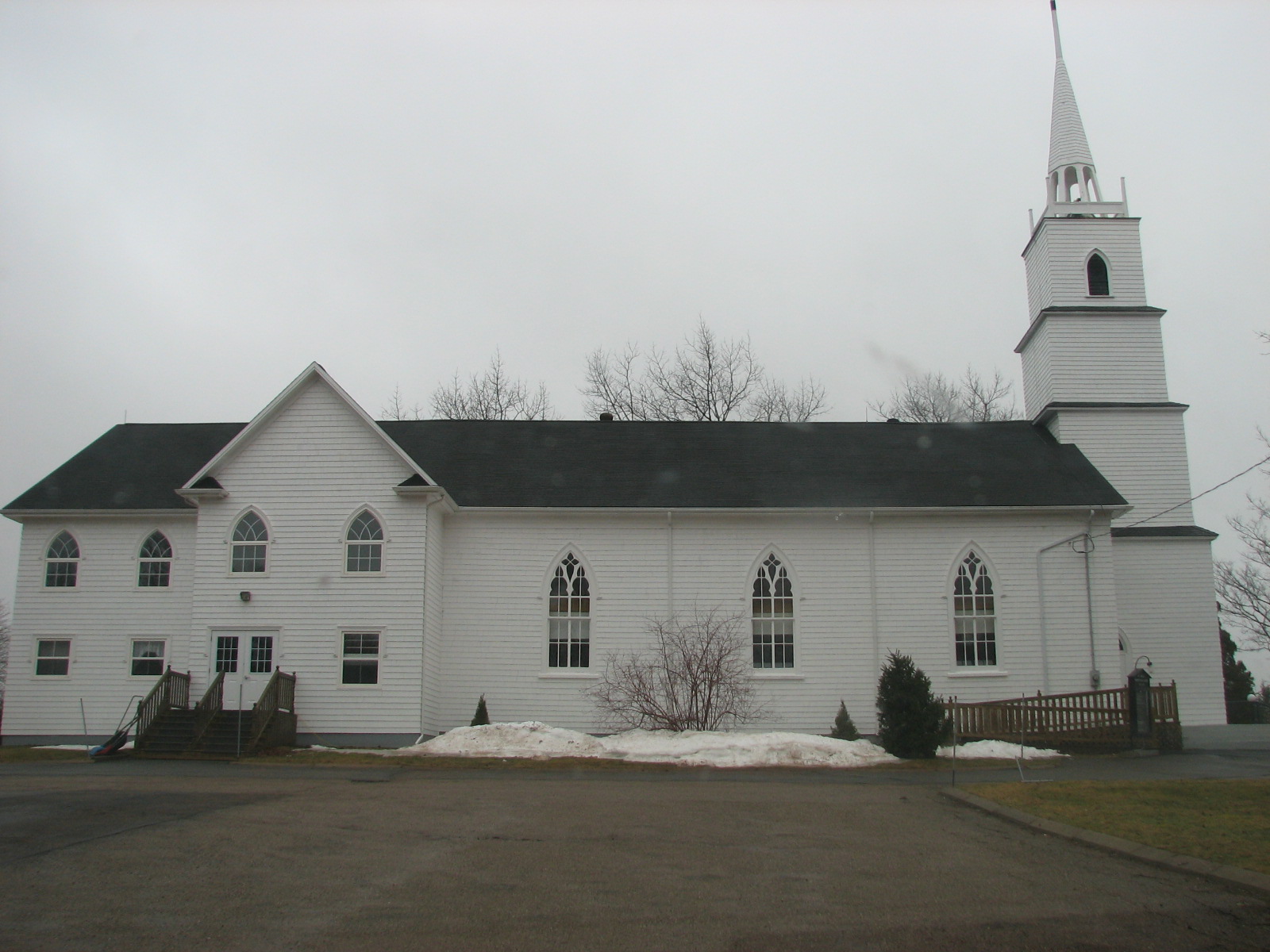
1840 New Glasgow United Church, Demolished 2011

Well my fears have been realized - the church is down - here's some photos I just took of the spectacle!
It amazes me to think the architectural detailing, ie. door and windows, weren't offered for salvage. 
In the Northern Star Newspaper September 2011 issue, Heather Dingwell in her monthly column, "The Dear Green Place" wrote about her feelings with the loss of this church.  Heather and her mother lived across the road from the church.  Here's the article, I scanned it vertically in 3 pieces.

New Glasgow United Church

I was out for a walk in the National Park this morning and upon return decided to drive through New Glasgow for a change - I witnessed 3 dump trucks and a Hi-mac (Heritage Building Destroyer) in front of this old church.  I will take a drive up later this morning to see what's going on.  I took most of the following photos a month ago and didn't get a chance to post them until now. 
This church was built as a Presbyterian Church around 1840 on the corner of  Rennie's Rd. (Rte. 13) and St. Ann's Rd. (Rte. 224) and was known as the "Big Church".  The church was moved to it's present location in 1888 and a section was cut-out of the middle to reduce it's size.  It was one of three churches belong to the Cavendish Pastoral Charge of the United Church of Canada.  Prior to Church Union in 1925 the church underwent an interior renovation along with some exterior renovations to the tower.  Due diminishing congregations and the need for many repairs, it was closed about 5 years ago.  The family who lives next door bought the lot and church and advertised the church for sale - to be moved.  They had no takers.  The church has been one of the character defining buildings of this small rural community, it faces south overlooking the Clyde River and over years had been nightly spot-lit, creating a very impressive view and atmosphere to this community.  The church has been the dominant subject in many, many tourism photos, calendars, websites, etc.
Below:  New Glasgow United Church on the Clyde River.
For more information see Historic Places website.
http://www.historicplaces.ca/en/rep-reg/place-lieu.aspx?id=9914

Monday, August 8, 2011

Church of Scotland, Belle River / St. John's Presbyterian, Belfast

Late on Saturday afternoon we stopped into the 147th PEI Highland Games and Scottish Festival at the Lord Selkirk Provincial Park in Eldon, PEI.  This 2-day event is presented by the Caledonia Club of Prince Edward Island.  For years I've been wanting to go out to this festival but never had the chance.  We had perfect weather and the day was beautiful.  The festival consists of the following: annual kilted golf classic; step-dancing competition; Jr. heavy sports demo & competition; Jr. athletics track and field; ladies heavy sports (ie. shot put, sprint, rolling pin toss); men's heavy sports (ie. shot put, sheaf toss, bale toss, Braemore stone, caber toss, farmer's walk; Highland dancing competitions; kilt pace; Belfast Pipe & Drum Band; Belfast Ceili Band; fiddlers and local musicians and performers.
A band of pipers started their performance and march in front of the Church of Scotland then paraded down into the Park grounds - it was moving to witness and to think this has been tradition here for near a-century-and-a-half.

The large provincial park features the following:  campground; golf course and clubhouse; swimming pool; historic Acadian/Scottish cemetery; the Belle River Church of Scotland and the Caledonia Club Crofthouse.  Below: looking over the Belfast Highland Greens Golf Course.
Below:  The Belle River Church of Scotland, built in 1876.  The church was no longer needed and moved in to the park from Belle River in the late 1990's.  The interpreter, Audrey, told us about the historic site and church and the area - she represents the Belfast Historical Society.
Below:  the west /front view.
The church is very simple in design and character.
Below:  the South / right side view.
Below: the East /rear view.
Below:  exterior detailing of window casing and sill.
Below:  opposite to the Belle River Church of Scotland is the entry to the Acadian/Scottish cemetery.  This area was the site of an Acadian cemetery between 1752-1758 and where they likely built their large Catholic church which measured 30'x70'.  The Acadians came here from Nova Scotia and were poor and destitute.  Nearly all these Acadians were deported to France in 1758 on the ill-fated ship "William" - only the Captain, crew and priest survived the sinking of the ship not far from France.
The first Scottish settlers were brought to this area by Lord Selkirk in August 1803 on the ship "Polly" - these settlers were known as "The Selkirk Settlers".  This Acadian cemetery became the resting place for many of those early Scottish settlers and was lost to time and an overgrown with forest until a few years ago when it was cleared and restored to its present state.  The Historical Society was presented with an award for this restoration project.

Those early Scottish settlers established the community we see here today and built their first church in 1824 - St. John's Presbyterian Church, Belfast (see below).  The church was built in the Neoclassical architectural style which resembles the designs of Sir Christopher Wren of London, England.  It was designed and constructed by Robert Jones who kept a detailed journal of his work - the journals survived and remain in the Jones family today.
I took these photos last spring, not this past weekend, although the rain and temperature here today feels more like late fall than mid summer!!
For more information see the following websites:

Saturday, August 6, 2011

Weeks House, Pleasant Valley - pending demolition

More sad news for those of us who hate to see heritage buildings destroyed - here's another house slated for demolition.

This house was built by John & Lydia (Craswell) Week's father in the late 1800's.  John's son Milton and his wife Adelaide Wigmore took over the farm following WWII.  The Weeks sold the property in the late 1980's - it's been sold a few times since and has been vacant in recent years.  The farm is located on Route 2 in Pleasant Valley, between the Smith Road and Floral Hills Memorial Gardens.  Most of the windows were recently removed and word around the community is that it will be demolished soon.  The house is Island-ell in style with much decorative trim.
Above & Below:  South view of the house, facing Route 2 Highway.
Below:  Note the decorative work on the portico eave line and the gingerbread trims.  The house had a square bay window, where the triple casement window is now - the bay window had trimming and a roof to match the portico.
Below:  The gable has a round-top attic window with board and batten.
Below:  The dormer above the kitchen wing has detailing matching the rest of the house.  Note the later addition of a shed dormer.
Below:  The east gable has elaborate trim including decorative-cut shingles.