Tuesday, January 14, 2014

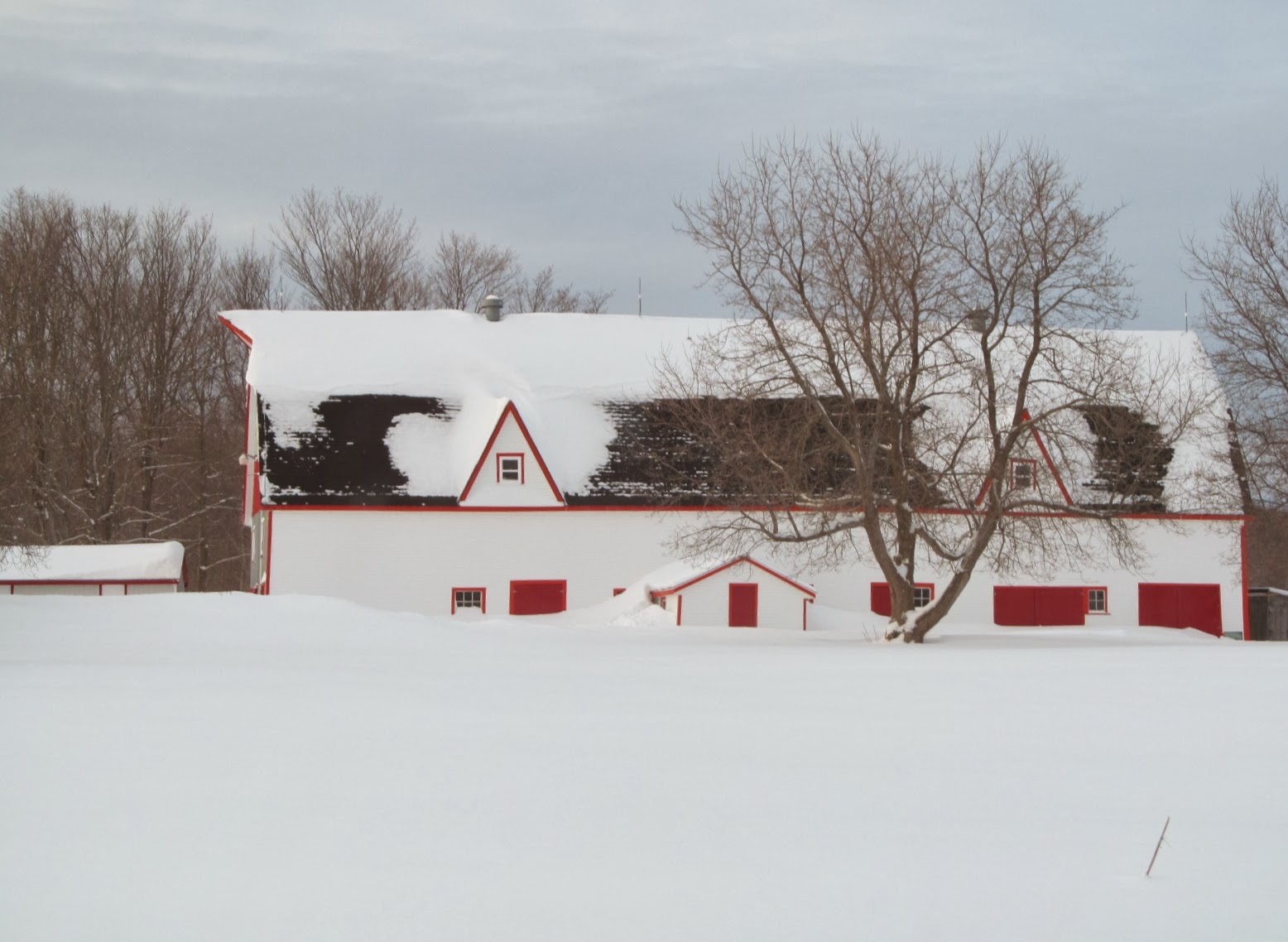
Doull-Clark "Rolling Bank Cottage", Wilmot Valley

     I've been noticing this old house for many years as I travel the Blue Shank Road between central and western P.E.I.   The house is set not far off Blue Shank Road on the MacMurdo Road (Route 120) in Wilmot Valley.  The house is situated on the east side of MacMurdo Road with the Wilmot River below/south of the house.
    Today I finally stopped to take a few photos with my smart phone - the real camera was at home.
     The house was built by George Doull about 1850.  George was a carriage maker - the 1861 Census taker notes that he had a shop near Rolling Bank Cottage and had made four carriages.  Later Doull moved to Summerside where he became known as a fine furniture builder.  Wm. Charles Clark (and Margaret Lefurgey) bought the house from the Doulls.  The Clarks had eleven children.   The following information cf.
     This house is in the "cross-gable" design which has a front gable who's eaves reach across from side-to-side of the front of the house to meet with the main house end gables.
     The Meachams's 1880 Atlas of Prince Edward Island shows this property belonging to Charles Clark with 100 acres.
     The Cumins 1928 Atlas of Prince Edward Island shows this property belonging to Fred Clark with 90 acres.  Married to Ethel Walker with eight children.
     Today the house remains in the Clark family.
Above: the Wilmot River to the left - to the right is the south yard of the house.

Mac Dixon's Mill 25 years later

     My brother sent me these photos yesterday as he was travelling around central PEI.  It's the old Mac Dixon Mill in South Melville.
     In my 67th post on this blog, June 2011, was about this old mill - these photo I took were taken in 1989 - 25 years ago.  Amazing to know the old mill is still here after all these years - although not in the greatest condition.
     In 1987 or 1988 two prominent Island businessmen talked about purchasing this mill and restoring it to operate as a tourist destination.
     In Meachams 1880 Atlas of Prince Edward Island it shows three separate parcels of land, each 50 acres around the mill, owned by John, William and George Beer.  It notes this as a saw mill.
     The McAlpine's Prince Edward Island Directory 1880-1881 notes Geo. Beer as a tanner; and Wm Beer with saw and grist mills in Hampton district.
     In Cumins 1928 Atlas of Prince Edward Island it shows Manford Beer owning the mill property with 80 acres of land.
     On the "Old Mills of Prince Edward Island" map by JoDee Samuelson 1996, it shows this as being a saw mill owned by the Beers. 
     So not sure when the Dixon's took over the mill.  I know Mac told us about his father going to Boston to get the bran duster.
Refer to previous posts about Mac Dixon and this mill...
http://peiheritagebuildings.blogspot.ca/2011/06/mac-dixons-grist-mill-south-mellvile.html
http://peiheritagebuildings.blogspot.ca/2011/10/dixon-mill-owner-obituary.html

Tuesday, January 7, 2014

McNichol-Best House, Cardigan

     The previous post of the Dundas farm may have a connection with the Best family (of Banting & Best, inventors of insulin).  Here's another connection the Best family has to Prince Edward Island - it's a house and property purchased by Dr. Best in Cardigan in 1973.
     The McNichol House of Cardigan is featured in H.M. Scott Smith's book The Historic Houses of Prince Edward Island on page 128.  ( sorry for the fuzzy photo - my scanner is not working - I took a photo ).  I will note a few excerpts from the book below to explain this house.
     The house is situated on the Cardigan River...It's a large rambling, multi-gabled house built partially of Island sandstone with multi-paned windows and a slate roof...It was built in c.1920 as a summer residence for James McNichol, a United States Senator from Philadelphia, and his wife, the former Margaret Donahue of Cardigan.  Senator McNichol died just prior to its completino.  In 1973 it was sold to the renowned Dr. Charles H. Best, co-discoverer of insulin.  Dr. Best died in 1978, but his daughter-in-law lived here after 1983.
     Below are drawings from the Prince Edward Island Public Archives and Record Office website.  http://www.gov.pe.ca/photos/original/P0002287.jpg

Saturday, January 4, 2014

Abandoned House and Barn, Dundas

      I took these photos in May 2009.  The house and barn are located in Dundas at #4371  Annandale Road (Rte. 310) not far from the side road, Dundas Farms Road.  
     Years ago there was a large farm in this area - something to do with PEI Government and an experimental farm.  I don't know more than that.  
     The house style is unusual for a rural setting.  It's an asymmetric, confused Queen Anne-like style with many additions and detailing.  It features three bay windows - on the left the bay has a square projecting dormer above; on the right a simple bay window with hipped roof; and on the front a 2-storey bay appearing as a set-in tower with a bell roof.  The house has a trapezoid gable/attic window and much gingerbread from eave brackets to verandah detailing.  The shed roof porch on the right front and side was likely once an open verandah.
     Here's a link to a 360 degree view of the large room on the main floor, left side of the house.   It looks like alot of files, file cabinet, etc. - must have been used as an office? Interesting!
     Here's one of the barns on the property - there are 5 or 6 more - I just photographed the older barn.  All is abandoned!

Friday, January 3, 2014

Books: Acadians of the Maritimes & Prince Edward Island

     My reference library has the following books on and about Acadian life and folklore - most have been translated in to English for folks like me who do not speak french.
     "Acadia of the Maritimes" features good information about the construction of the Acadian home.  
     The following books (not a complete list) about Acadian life on Ile-du-Prince Eduoard /Prince Edward Island are by well-known Acadian historian Georges Arsenault - must-have books about Acadians.
     The following images come from http://www.amazon.ca/ website. 

St. Augustine's Parish Church, Rustico celebrate 175 years

     The first service held at St. Augustine's Roman Catholic Church in Rustico was held on Christmas Eve 1838.  Beginning Christmas Eve 2013 the Parish will continue to celebrate it's 175th Anniversary through-out 2014. 
     Construction of the church began in late summer of 1838.  A letter between the Priest at Saint-Henri de Barachois, New Brunswick and the priest at St. Augustine talks about the new church at Rustico.
     Fore more information of the 175th Anniversary see the following article in the Guardian newspaper...
http://www.theguardian.pe.ca/Living/2013-12-05/article-3530725/P.E.I.-church-celebrating-strong-connections-to-the-past/1
Below images cf. Historic Places Website
St. Augustine's Roman Catholic Church
Above: Image from Meachams 1880 Atlas of PEI
     Below: "In Rustico Chapel: Acadian Nuns at prayer" sketch by Robert Harris, late 19th-century
"In Rustico Chapel, St. Augustine, Rustico, PEI"

Monday, December 30, 2013

Gordon-Barbour House, Montrose

     I was out to Montrose the other day and took these photos of the Jack & Kay Barbour home.  The house is located on Rte. 152 leaving Alberton, between Huntley and the Montrose Bridge.
     This large "Fox House" (more commonly known as "Four-Square" style) was built in 1914 for Robert Hudson Gordon, one of the local pioneers of the fox farming industry on Prince Edward Island.  The carpenter was Robert Rankin.  
     The very large (one of the largest in western PEI) 2-1/2 storeys house has a hipped roof complete with large dormers on each side.  There are shallow bay windows and a partial wrap-around verandah with round columns.  This house always been well maintained and today is in excellent condition.
     During the 1930's the house came up for offer and was purchased by Roy Barbour and his family - Roy's son Jack and his family remain here today. 
     The large barn and out-buildings are also in very good condition - always well maintained.  The property is large with mature trees all around.

Tuesday, December 17, 2013

Beaton House, Summerside

     I also took a few photos of this house today at 27 Granville Street in Summerside. It has impressive detailing, influenced by Gothic Revival and Queen Anne architectural styles.
     The house was originally owned by M.F. Schurman and located on Eustane Street - it was moved to the corner of Granville and Hanover Streets in 1907.  Most of the homes in this area had been destroyed by the Great Fire of 1906.  Mr. Schurman engaged "a small army of carpenters, masons and labourers to carry out the reconstruction".  Mr. Schurman and his family lived here from 1908-1916.   The house changed hands a few times until 1941 when Samuel and Linnie Beaton purchased the house and lived here for more than 40 years.
     For more information refer to the historic places website...
http://www.historicplaces.ca/en/rep-reg/place-lieu.aspx?id=10075
 Above/Below: West front of house, facing Granville Street.


Calhoun House, Summerside

    This house is located at 39 Eustane Street in Summerside.  I took these photos this afternoon.  I always found this house an interesting old design, however, it dates to about 1870.  Here's a link to more information...
http://www.historicplaces.ca/en/rep-reg/place-lieu.aspx?id=16237&pid=0
 Front of the house, facing south, a couple of streets back from Water Street.
The house as described in the late 1800's...
     'The advertisement for the house had stated: "The Dwelling contains eight Bedrooms, besides Parlor, Sitting, Dining and Bath Rooms, inside and outside Kitchens... The cellar is stone and brick and frost proof... The grounds are large and very suitable for a Hotel... There is a large Barn and Hennery on the premises. The east, west and south sides are surrounded by Elms, Maple, Lilac and Fruit trees, which gives the premises a rustic appearance." The purchaser of the property was Harry T. Holman, well known as one of the owners of the large mercantile firm of R.T. Holman Limited. Mr. Holman was married to Constance Eva, a daughter of Mr. and Mrs. Wright. He resold the Eustane Street property to local bakery owner, H.H. Lefurgey.'
 Above: East side of the house.
 Above: Rear, northeast view.
 This side of the house faces west on to Eustane Street.  Note the old elm tree stumps.


Friday, December 13, 2013

today is "Acadian Remembrance Day" - Dec. 13

     I received this email from Georges Arsenault this morning complete with links to further information!
**********************************
Bonjour,
      On this December 13, Acadian Remembrance Day, I am sending you this article on Noël Doiron who was drowned when the ship Duke William sank on December 13, 1758, during the Acadian Deportation. He died with almost all the members of his family and hundreds of others. This Doiron family, originally from Nova Scotia, lived at Eldon which was called at the time Pointe-Prime.
      Article : http://en.wikipedia.org/wiki/No%C3%ABl_Doiron
     You can also see a short video on Noël Doiron and wife Marie about when they were living in Nova Scotia in a village now called Noel.
      Video : http://hohants.weebly.com/6-noel-and-marie-doiron.html
     The article and the video are the work of two brothers from Nova Scotia, Todd and Shane Scott. They have greatly contributed to make known the story of the Doirons and of the sinking of the Duke William.
     You can also listen to a CBC Radio Documentary entitled "Noel Doiron and the Wreck of the Duke William"  - http://www.cbc.ca/maritimemagazine/archives/jan_w4.html
    A ceremony on this Acadian Remembrance Day will be held at noon today at the Port-la-Joye -- Fort Amherst Historical Site. All are welcomed.
**********************************
     Noël Doiron (Port-Royal, 1684 – December 13, 1758) was a leader of the Acadians, renown for the decisions he made during the Deportation of the Acadians.[1] Doiron was deported on a vessel named the Duke William (1758). The sinking of the Duke William was one of the worst marine disasters in Canadian history. The captain of the Duke William, William Nichols, described Noel Doiron as the "head prisoner" on board the ship and as the "father" to all the Acadians on Ile St. Jean (present-day Prince Edward Island).[2]
     Second only to Evangeline, the most well known Acadian story of the Victorian era was that of Noel Doiron (1684-1758). For his "noble resignation" and self-sacrifice aboard the Duke William, Doiron was celebrated in popular print throughout the 19th century in England and America.[3] Doiron also is the namesake of the village Noel, Nova Scotia and the surrounding communities of Noel Shore, East Noel (also known as Densmore Mills), Noel Road and North Noel Road.
     Early in 1750, Noel Doiron and his family joined the Acadian Exodus and left mainland Nova Scotia for Pointe Prime, Ile St. Jean (present day Eldon, Prince Edward Island).