Wednesday, July 23, 2014

St. Simon and St. Jude Parish Church - Interior photos

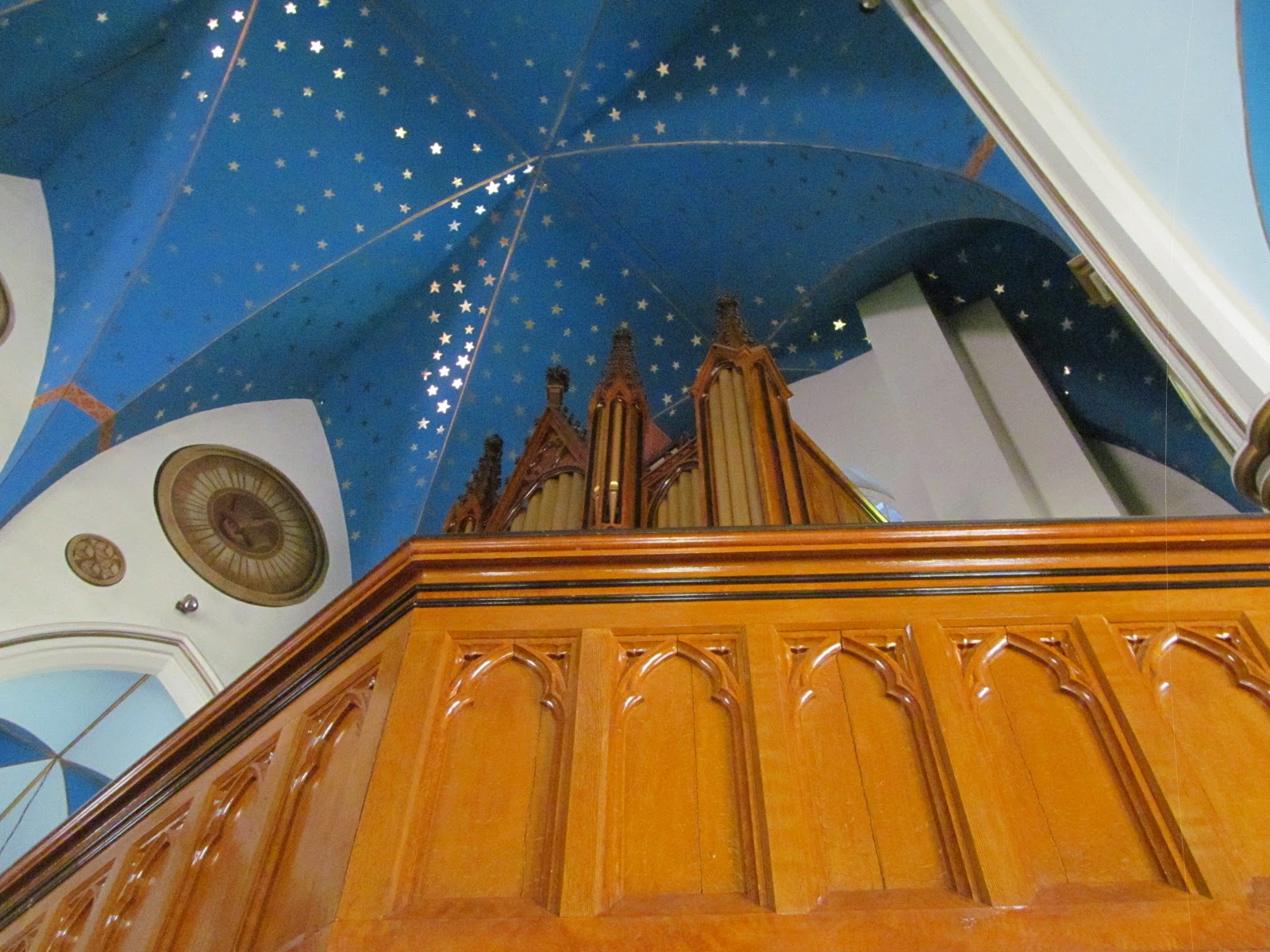
     The interior of St. Simon and St. Jude Church is awe inspiring.  The blue ceiling is brilliant with gold stars - you can't stop looking up.  The interior was painted by Cathedral Painters of Nova Scotia in the 1990's.
     Also during the restorations in the 1990's a replica of the original altar was built.
     There's also an 1882 Louis Mitchell (Montreal) Organ in the church - during summer months recitals are held regularly. http://www.cbc.ca/news/canada/prince-edward-island/1880s-pipe-organ-being-restored-1.1055305
       St. Simon and St. Jude church is a must visit - well worth the drive from anywhere on Prince Edward Island!
Below are photos from the Side Chapel.

Saturday, July 19, 2014

Bideford Parsonage House

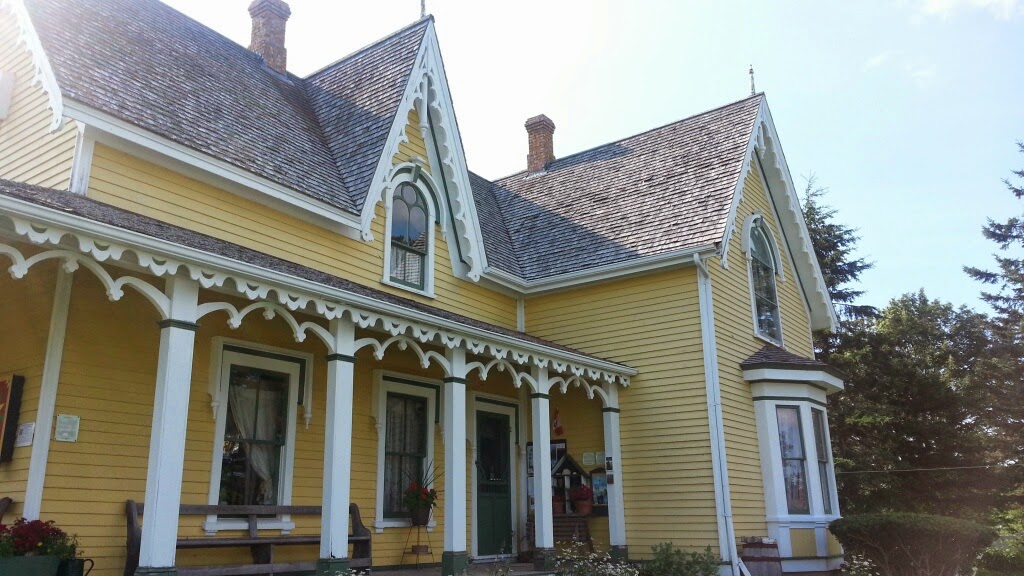
     I was up to the Tyne Valley area yesterday afternoon for work.  I took the following photos of the Bideford Parsonage House.
     At the time this house was restored all the eave and gingerbread trimming had been removed - my brother Kerras (of Backroad Folkart) made all the new trimmings from Island Cedar.  See article about his work... http://backroadfolkart.blogspot.ca/2013/02/gingerbread-trims.html
The following information comes from their website.
     This Victorian home is pictured in the Illustrated Historical Atlas of the Province of Prince Edward Island (image below from Historic Places website) that was published by J.H. Meacham & Co. in 1880.  It was the residence of T.H. Pope, accountant and telegraph operator and was constructed in 1878 for Mr. Pope and his wife, Susan Elizabeth (Eliza) Yeo.  Two of their daughters were born while they lived in Bideford.  A copy of the deed for the land from the Government of Prince Edward Island to Thomas H. Pope for the sum of $2.00 on the wall in the foyer.
     On July 10, 1884, the house was purchased by the Methodist Church for the use as their Parsonage and was home to many parsons and their families over the years.  Following church union in 1925, the house became the manse for the Bideford United Church, until it was sold as a private dwelling in 1975.
     When the house came up for resale in 1999, the local community, upon hearing that it was to be sold and moved out of the community of Bideford to Cavendish, reactivated the West Country Historical Society.  The society became incorporated and purchased the home, turning it into a museum with three distinct themes – that of the ear of shipbuilding when the house was constructed; the contribution made to the community by the clergy and their families over the years; and thirdly, and perhaps what has created the most interest for the pubic, is the fact that author Lucy Maud Montgomery boarded her from Aught 3, 1894 until May 11, 1895 while teaching in Bideford No. 6 School.
* * * * * * * * * * * *
     Just up the road a short distance is the Bideford-Conway United Church, formerly the Bideford Methodist Church.  The church was built in 1888 and dedicated in 1890.  For more information see: http://marconf.ca/37556-bideford-pastoral-charge/

Thursday, July 17, 2014

Carroll-Reeves House on the Trout River, Carleton

     I was by this old house a few weeks ago - it's located on the shores of Trout River, at 464 Trout River Road (Rte. 137) between Rte. 12, Roxbury and Rte. 2, Carleton.
    Meacham's 1880 Atlas of Prince Edward Island shows George Carroll living here with 44 acres. The map shows the property to the southeast of him was owned by Cyprian Aresnault who had a "ship yard" down at the River very close to the Carroll-Arsenault property line.
    Cumins 1928 Atlas of Prince Edward Island shows P.P. Reeves living here with his wife Annie and children: Hariet, Vera, Thomas, Russell and Sterling.  He also had 44 acres.
     Today the property is owned by a farming corporation .
     The house is a "center dormer" style house, likely built in the 1880's - Meacham's Atlas shows a house in this location - possibly this one.
     Below is a real estate sign nailed to the power pole - it's an old one as the Oulton's got out of the business a couple of years ago.

Tuesday, July 15, 2014

Elite Seed Farm, former Ashley Homestead, Fox Island

     Recently I was over to Fox Island in western Prince Edward Island.  It's located at 269 Fox Island Rd., off Rte. 12, between Alberton and Cascumpec.  
     Cumin's 1928 Atlas of Prince Edward Island shows the Island belonging to Lowden Ashley with 182-acres. Lowden was married to Susan Lewis and had the following children: Rhodes, John, Gladys, Alvin, Elmer, Freda, Fred and Harold.  
     Lowden *Loudy* Huestis Ashley (1877-1953), son of John Butcher Ashley and Sarah Stapley Wallace married Susan *Susie* Lewis (1878-1947) in December 1898.  They lived on the part of the Ashley farm and later purchased the west end of Fox Island from his uncle, Fred Wallace.  Loudy and Susie then moved to Fox Island where they raised their family of eight.  Loudy was a farm and fox rancher.  Info cf. http://www.ancestraltrails.ca/
     When I worked at Maplewood Manor, Alberton, in the summers of 1981-82, Gladys (Ashley) Bonyman was a resident - she was in her 80's.  She often told us about growing up on Fox Island and recalled Mik'maq families coming back to the shores of the Island to spend the summers.  One of her vivid memories was seeing a native woman giving birth.
     See 2008 Guardian newspaper article below telling history of the seed farm which was established in 1962.
 Below: Front of house, facing Northeast.
The house is a "Fox House" style home, likely built just before WWI.
     Below: northeast view from front of house looking towards Dock River and Alberton.
Below: Southeast side of house.
 Below is a barn standing out by itself as you drive up to the property.
     Below is an article from the Guardian newspaper six years ago about the Elite Seed Farm.
- Elite seed farm topic at potato board meeting -
The Guardian. By Nancy Willis. Published on February 27, 2008
P.E.I. Potato Board holds first of four Islandwide annual meetings in Rollo Bay
ROLLO BAY - The P.E.I. Potato Board held the first of its four Islandwide annual meetings here Tuesday, where the future of the Fox Island Elite Seed Farm was of key interest.
            This industry owned seed farm has been a fundamental part of the Prince Edward Island potato world for more than half a century.
            Unlike similar organizations that are nationally funded in the United States, or provincially backed in New Brunswick, the P.E.I. Potato Board is supported completely by local Island growers.
            This year, it cost those producers $217,000 to keep it running and the board decided it was time to take it to the farmers and let them decide what to do with it.
            For decades, the elite seed farm was an international showplace for visitors, and throughout its lifetime it has ensured commercial Island growers that a local source of clean seed would be available to them.
            Now dramatic changes in the potato world, a decrease in the numbers of varieties allowed to be grown there and increased private ownership of seed worldwide have all contributed to the farm not making a profit for the last few decades.  "A variety of factors are also at play, including lower production acreage than in the past; the implication of various regulatory scenarios; and lower virus levels in seed now, which translate into less demand for early generated seed,'' said staff member Mary Kay Sonier.
            Although the farmers were presented with a variety of alternatives, no one was interested in getting rid of it. A few of the many options included maintaining the status quo; selling the property and getting out of early seed production, or continuing with nuclear seed production and trying to expand the varieties they are able to grow.
            Keeping the farm going and maintaining it as a safety net for the industry future was clearly the chosen path. All seemed to agree that the percentage of their dues that went to keeping it running was relatively small, and that keeping it was to everyone's benefit.
            "We now need to know what direction the growers would like to take because there is much to be done out there, and that will depend on the direction we choose,'' said board chairman Kevin MacIsaac.
            "Well, I don't see anyone jumping up and down to say sell her and make cottage lots,'' said Eastern Kings farmer Boyd Rose. He suggested looking at opening up the variety restrictions and lowering the price of the seed they sell so it is more competitive with commercially available product.
            This and a raft of other topics and issues will be discussed at meetings in Mill River Thursday afternoon, and Summerside Thursday night.

* * * * * * * * * * * * * * *
Below is the map from Meacham's 1880 Atlas of PEI showing Fox Island.

Monday, July 7, 2014

Murray River Train Station - Demolished today

     Lately my blog is becoming a register of demolished buildings!  Today the 110-year-old  Murray River Train Station was demolished.
The Murray River village council in eastern P.E.I. decided to tear down its old train station.
Photos cf. CBC PEI's website post today...
Murray River train station

Brown Sisters House, New Glasgow - Demolished

     One day last week we saw this house and lot, located on the northwest side of the bridge in New Glasgow, being cleared of the trees and brambles that have grown up over the past few years and wondered what was going on.  Well, a trip through New Glasgow yesterday told the story, it was demolished.
     Locally, this place was known as the Brown Sister's summer home - they lived in town and came out to New Glasgow for the summers.  Their 1.2 -acre property goes down to the water / Clyde River, across from New Glasgow Lobster Suppers.
     The house was sold sometime around 2009 but wasn't used much - it was for sale again recently.
The photo below was taken in March 2003
The Photo below was taken in May 2003
The photos below were taken in March 2007
The following photo was taken on February 18, 2012.

Sunday, July 6, 2014

Burke Gardens, Southport (Stratford)

     We often hear references to local markets and farmers markets in our history books, however, we never hear much about those who supplied goods and products to those markets - we always assume they were farmers.  The other evening "The Burke Gardens" was brought to my attention.  I did a bit of research and found this information from, A History of Southport, published in 1982 and the Historic Places website.
* * * * * * * * * * * * * * * * *
The Burke Gardens
            Approximately 1880, James and Mary Burke of Alexander moved to Southport, to the home formerly owned by James’ brother Walter Burke.  They had four children at the time and eight more were born after that.  The youngest son, Ernest, is still living in Southport.  James was a marker gardener (as listed in the Atlas of 1880) who took his produce to the Market in Charlottetown.  When he died in 1895, his son Arthur, at the age of 16, took over the business and the property.  He continued on with it until 1930. Ernest started going to the Market with his brother in 1907, at the age of 15.  He married Della P. Clark in 1919, and built a home on the property next to Arthur’s, formerly owned by a Walter Ogar.  He continued in the market-garden business with his brother until 1930 and then branched out on his own that spring.  Ernest and Della took the produce and flowers to market twice a week until 1942.  After that, until 1965, the seedlings that were grown in the green house each spring were sold from the house in Southport and the vegetables were taken to the stores.  Della died March 29, 1971 and Ernest has continued to live in the homestead, growing flowers and vegetables for his own use.

Above cf. A History of Southport and District: including Rosebank, Keppoch and Kinlock.  Page 22 & 23.
Published by the History Committee of the Southport Women’s Institute in 1982. Edited by Jim Hornby.
 Showing southwest elevation
Image cf. http://www.historicplaces.ca/en/rep-reg/image-image.aspx?id=15212#i3
The Burke House, 2 Glencove Drive
            There is no record of when this house was built but when Dr. Lantz bought it and had it renovated about seven layers of paper were stripped from the walls.  Walter Burke was a brother of James Burke and he must have passed the property to James; in the 1880 Atlas the name James Burke, gardener, is recorded.  The house passed to Arthur Burke, and he and his wife Beatrice lived there for many years.  The property now is in the possession of Eugene MacDonald.
Info cf. A History of Southport, Page 69
Location of William Burke's Glen Stewart Farm
Image and info below cf. 
http://www.historicplaces.ca/en/rep-reg/image-image.aspx?id=15212#i3
     This Maritime Vernacular style house is valued for its historical association with the early history of Stratford.  Constructed in 1840, it was the site of Glen Stewart Farm which was established by the Burke family. For a few years in the 1870s, the house was occupied by Robert (1811-1878) and Augusta May (1812-1875). The Mays had emigrated from England in 1862. Robert May died in England, while the rest of the family, Augusta and her daughters, Harriet (d. 1918) and Emma (d. 1901), are interred in the Anglican cemetery in Stratford. The noted PEI architect, William Critchlow Harris and his brother, the painter, Robert Harris are known to have visited the house when the Mays lived there. W.C. Harris notes in his diary that in 1872 he and his sister, Sarah, crossed the harbour from Charlottetown to Southport (now part of Stratford) on board the steamer "Ora" to visit the Mays. While there, they played croquet, had a "bountiful meal", and sang songs into the twilight hours. By 1880, Meacham's Atlas of PEI shows William Burke (1833-1902) as then residing on the property. Shortly after this time, Glen Stewart Farm became the property of William's brother, James Burke (1847-1895) and his wife Mary (Burhoe) Burke. They established a market garden on the farm which grew produce to sell in Charlottetown's Market which was located in Queen Square on the site of the current Confederation Centre of the Arts. When James passed away in 1895, his son, Arthur, who was then only sixteen, took over the business. He continued to operate the market garden until 1930. In the 1940s, the house was purchased by Dr. J.P. Lantz. He was a graduate of McGill's medical school, but was known on PEI for his award winning Aberdeen Angus and Jersey cattle. The current owners purchased the house in 1964. During renovations, they discovered that copies of the "London Times" from the 1840s had been applied to the original walls as a form of insulation. Although renovated over the years, the house retains elements of its original design and has many important historical associations.

Saturday, July 5, 2014

Station Agents House - 1904

     Here's an article about the Lower Freetown Station Agents house, moved to Augustine Cove in the early 1990's.  Today it is a summer rental property - http://www.homeaway.ca/cottage-rental/p388753vb
     Many communities on the Island with train stations had Station Agents homes built from this same plan. 
 Below: Page from PEI Heritage Designs Book.
 Below: Copy of original drawings from PEIMHF.
Here's the Station Agents House in Hunter River.
 Below: cf. CIHB (Canadian Inventory of Heritage Buildings) 1974
Below: Hunter River Postcard - Station Agents House on left - 1909
Below: Hunter River Postcard - Station Agents House on left 1926