Showing posts with label Fire. Show all posts

Friday, August 4, 2017

William Hyde Sr.'s Octagonal House, Meadowbank

     I recently picked-up a copy of "Our West River Heritage" by Violet MacEachern & Arlene MacDougall (January 1993) and was interested to read about an octagonal house built here on Prince Edward Island.  The following is from page 20.
     "It is interesting to learn that William Hyde, Sr., built a large, two-storied, eight sided house which contained a ballroom on the second floor.  This house was a social centre where Members of Parliament were often entertained.  (He was an M.P. for two terms (1812, 1818 & 1825?)).  This fine home was destroyed by fire, about the year 1857, when two Hyde sisters were the only occupants.  Two valuable pieces of furniture were saved from the flames: an antique grandfather's clock, and a sixteen-legged table made of black birch.  All the correspondence with relatives in the old country, England and Ireland, was destroyed severing family connections."  
     William Hyde Sr. was born in 1763 in County Clare, Ireland.  His occupation was listed as militia, farmer and politician.  In 1787 he married Christina Simpson of Cavendish - they had ten children.  William was a member of the Prince Edward Island Provincial Legislature.  William died on October 23, 1831.  ( Info cf. http://www.islandregister.com/hyde.html )
Will of William Hyde the Elder of Elliott River Settlement On Township Number 32, Esquire. /// Liber 2 Folio 187 /// To my dearly beloved wife Christiana for life, the House I now reside in with the furniture and 90 acres or therabouts adjoining, with the Barn, and one half of the Stock, Crop, etc., she to allow her daughters, Ellen, Jannett, Mary, and Sarah to live with her as heretofore until they may be married, then to receive one milk cow and six breeding ewes. They may remain on said land after mother's land if unmarried or widows; lands to go eventually to sons James and John equally. / To son William, Freehold farm he now occupies of 110 acres "and forming a point or peninsula fronting on Elliott River and Mill Creek". / Freehold Farm of 110 acres occupied by late son, Thomas (description given), to his widow, Caroline, and children "born and to be born," till the eldest son is 21, he then to take a double portion and to give his brothers and sisters an equal portion (etc.). / To my son, James the remainder of the freehold whereon I at present reside, etc. of 110 acres. / To son John, the leasehold farm called the Mill Farm, on 100 acres, with Mills, etc, but sons James and John to have equal shares in the Mills, etc. (Plan of farms, all on Lot 32, attached.) John to have one half of the upland hay. To James, lot No. 31 in 2nd Hundred in Charlotte Town. To son, John, Lot No. 32, in 2nd hundred of lots, in Ch'Town. To son John and James the other half of the Stock, Crop, and Farming Utensils in my possession, equally, and all other Personal estate not before mentioned, they to pay just debts, and Funeral expenses. / All children directed to continue dutiful and obedient to their mother. / Having equal regard for all my children, I do not omit to notice my daughters Margaret, the wife of Mr. Thomas Tod, and Anne, the wife of Mr. John Cameron (who received portions at marriage). / Sons James and John Executors. Dated 25 Aug. 1831. / William Hyde, L.S. / Witnesses:  John Crosby, James Crosby, Chas. Binns. / Probate granted 9 Jan., 1832. (Reg of Probate, #18).  Above cf.
* * * * * * * * * * * * * * * * * * * * * * *
     The 8-sided house was a phenomenon created in the mid-nineteenth century by Orson S. Fowler, an American, who published "The Octagonal House: A Home for All" in 1848. Fowler was an amateur architect and lifestyle pundit and a proponent of the octagonal house (cf. wikipedia).  This would not apply to the  Hyde House as it was built prior to the death of Mr. Hyde in 1831. 
     I do not know of any 8-sided houses built on Prince Edward Island, however, there have been a few barns.  Below is the Capt. George Anderson's 2-storey octagonal house in Sackville, New Brunswick - built in 1855.  In the mid twenthieth-century the house was used for many years by the Enterprise Foundry Company.  In 1989 the Town of Sackville purchased, moved and restored the house - today it's a Visitor Information Center.  ( http://www.historicplaces.ca/en/rep-reg/place-lieu.aspx?id=6844 )

Tuesday, November 1, 2016

Former Bishop McIntyre/MacFadyan/Cran House, Tignish - Destroyed by Fire!

     OK- this is a bad day!!!  One of Prince Edward Island's more historic homes was destroyed by fire last evening in Tignish! 
     My brother was in this house back in April of this year and took the following photos!  He was back here a couple of weeks ago and bought an old table from the owners.  I was awaiting permission from the owners to document and measure the house for archival purposes!
 
 Below is a painting I acquired last spring of Bishop McIntyre.

Below is a post made on Facebook a few hours ago by Architectural Historian Reg Porter.
THE TRAGEDIES OF HALLOWEEN
     In the 1960s my friend Elizabeth Cran and her children Alison and Anthony and I spent every summer in this huge house managing a long-term project in promoting community culture called the Tignish Arts Foundation. The house had quite a history, having once belonged to Bishop Peter McIntyre who used it for his home when he was parish priest of the area in the 1840-60 period. Later it was bought by a Protestant merchant, Alexander MacFadyen who worked for the Myrick commercial interests. He added on a very large piece on the right and turned the original Georgian house into the new Colonial Revival style. I loved that house and for many years dreamed of it being my home for life. But life had other plans for me. Elizabeth however, did live there for quite a few years.
     Last night, Rose just told me, vandals burned the house down as part of their vile Halloween celebrations. Now all that remains is a framed photo that has all my mature life hung on the wall of my study, wherever I lived. The photo fades but the memories glow.

Saturday, October 31, 2015

O'Connell-McCabe-O'Shea Store, Iona

    The previous post in this blog show's this old country store in Iona being destroyed by fire yesterday.  It was located at 1788 Iona Road where it intersects with the Selkirk Road.
     According to CBC PEI News online today, the store was owned by Leo and Florence O'Shea who had operated O'Shea's Grocery here until 1993 and since it was not a store.  The family also noted "...it had been in operation for 200 years."
     Below are photos from Google Maps.
     According to Meacham's 1880 Atlas of Prince Edward Island (see map below from the Atlas) the store was owned by Jno O'Connell with 2 acres and a Store.
     In the Cumin's 1928 Atlas of Prince Edward Island, the store was owned by James McCabe with 10 acres.  It notes he was married to Annie (Anastasia Cairns) with the following children:  Annie, Mary, Margaret and Louise.  According to the McCabe genealogy on the Island Register ( http://www.islandregister.com/mccabe1.html ) James' (1859-1942) daughter Mary J. (1897-1961) "...owned and ran the McCabe store in Iona."

Friday, October 30, 2015

Former store & barn burn, Iona

CBC PEI News report-
http://www.cbc.ca/news/canada/prince-edward-island/pei-house-fire-iona-1.3296605
House, barn fire underway in Iona, P.E.I.
Belfast firefighters have shut down a portion of Route 23 while they fight fire
CBC News Posted: Oct 30, 2015 12:59 PM AT Last Updated: Oct 30 1:40 PM AT
The fire in Iona was discovered by a passing driver around noon Friday.
( Submitted photo )
     RCMP and firefighters are on the scene of a house and barn fire on P.E.I. at the intersection of the Selkirk and Iona Roads.  The Belfast Fire Department is working to fight the blaze and have closed a portion of Route 23.   Staff Sgt. Kevin Bailey of Montague RCMP told CBC News officers were the first on scene shortly after noon.   "It appears that the fire is likely going to affect both the barn and the attached house," said Bailey.  "Both will likely be a total loss."   Bailey said the residents were not at home at the time. Their relatives are at the scene.   RCMP are asking drivers to avoid the area. 
                                                                                                  - With files from Angela Walker

Saturday, May 2, 2015

Old Barn burns in Knutsford

     The following article appeared on the Guardian newspaper's website: http://www.theguardian.pe.ca/News/Local/2015-05-01/article-4132014/Faulty-lightbulb-caused-Knutsford-barn-fire/1
Faulty lightbulb causes Knutsford barn fire
Published April 30, 2015 - Eric McCarthy/ Journal-Pioneer 
KNUTSFORD — A faulty light bulb is the likely cause of a fire that destroyed a barn in Knutsford Thursday afternoon, O’Leary Fire Chief Blair Perry reported.
The call to the property of Ralph and Sherren Sweet went in to the O’Leary department shortly after 2 p.m. and Perry said they immediately called in West Point and Alberton Fire Departments for back-up and to assist with a water shuttle.
By late afternoon Perry called in a hi-mack to rip steel from the roof of the structure so that firefighters could get at the smouldering bales of hay and straw.
The machine didn’t have far to travel, as the barn fire is located directly behind Matthews Lime Spreading’s heavy machinery yard. The owner of that property had moved some of his machinery out of harm’s way shortly after the barn went ablaze.
Fire damage was confined to the barn. Perry said it contained hay and straw but no equipment or livestock. 

Monday, November 4, 2013

Former Alley-Myrick Summer Home burned at Halloween

     The previous Post in this Blog tells about the Halloween fire at the former Davis Lodge at Tignish.  The lodge/house was located on the corner of the Route. 12 (shore road) and the Christopher /Tignish Shore Road.   The house was close to the bridge that crossed the Big Tignish River. 
     This was built as a summer home by John Alley and later given to James II & Sybil Myrick.
     Below are photos from The Myricks of Tignish book with the exception of Eric McCarthy's photo of Nov. 1st and the PEI Gov't website 1935 map.
Above: an early photo of the Alley-Myrick Summer Home, Tignish.
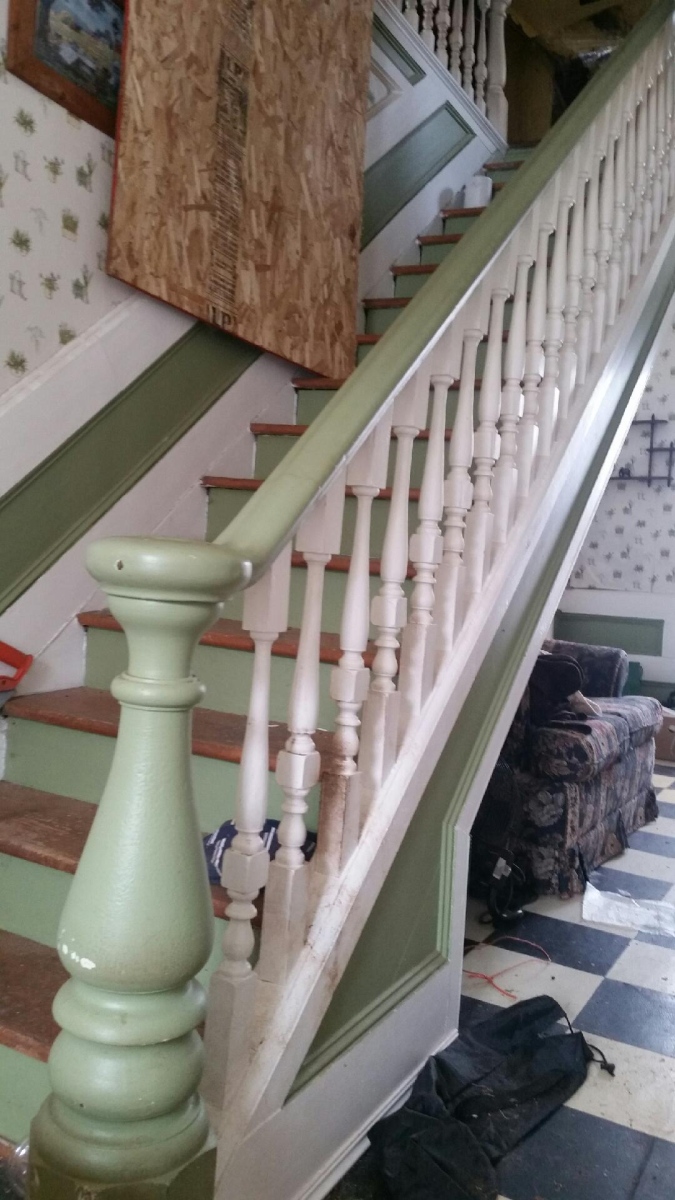
"In 1913 Uncle John Alley gave James Howe Myrick II and his wife Sybil Stone (married in 1911) this house as a wedding gift".  The stairs were built of birds-eye maple.
* * * * * * * * * * * * * * * * * * * * * *
     Below: the November 1, 2013 fire completely destroyed the new addition. - you can see the original house left standing.  Note the open porches had been filled-in, the gable double window with diamond pattern still remained along with the large chimney.  The entire building was knocked-down later that day.
Above Photo by Eric McCarthy. Journal-Pioneer Newspaper.  November 1, 2013.
The Myricks of Tignish
     The story of the Myrick's family is told in a book published in 1995 by Carolyn Myrick titled, The Myricks of Tignish: 1853-1969.  Below are excerpts from the book starting with the Preface...
     "Have you ever built a grand sand castle at the beach only to have it washed away at high tide?  In the century from 1850 to 1950 at the Myrick shore in Tignish a whole business community was prospering.  Twenty-one separate buildings existed where people who lived at the Shore worked and came to depend on the store, fishing, and the canning enterprise.  There were other Myrick activities around the island, but all are gone now, like a sandcastle.  But have you ever seen initials carved in a tree trunk with an old date?  The initials and the date remain as the tree grows.  So has the Myrick influence endured while the Island has grown around it.  In the early 1930s John B. Myrick was finding business at the store slipping because of competition and he saw that the fishermen needed income other than fishing.  He developed the Irish Moss industry, which is bringing prosperity to much of the West Prince area today.  Ever since I married Roger Myrick I have heard that there should be a book written about the Myricks. As the other family members died those of us left realized if it was ever to be done it should be now...After Sybl Myrick died we had her diaries, but almost ten years passed after her death before I could bring myself to read them.  Then I started in earnest and each summer while we were at the Island I did research at the Archives in Charlottetown.  The diaries have been most helpful through the years..."  Carolyn E. Myrick.  Page 11
    "Why is it called Number Three?"  I asked Rog.  "In the days when they first had telephones my Uncle Joh rigged up lines from the store at the Shore, the Tignish station store, our house, his house, Grandfather's, and Mr. McFadgen's, the Tignish store manager.  Their house was up beyond Uncle John's, down a long driveway.  Each place had a different number of rings.  The Tignish Shore store had one, the store at Tignish station two, Grandfather's three, McFadgen's four, Uncle John's fire, and our house six."  Page 15-16
Number 3
     "Number 3 was the three-storey house Merrill had built himself when he was first married in 1884.  When he built it, he told Rog, there was an open field between the house and Tignish center, so that he could sight from the foundation of the house ot Tignish church of St. Simon and St. Jude.  Rog's parents had lived on the third floor of Number 3 when they were first married.  After Rog was born they moved next door to number 6, a summer house, built by his grandfather's brother-in-law ((the Alley's)).  In 1883 the bark "Minnie Gordon" had blown ashore at North Cape loaded with lumber for England.  Rog's grandfather bought the cargo from the owner and used the lumber for building the house.  The masts and spars were of beautiful hard pine and he used them for the floor and mantelpieces.  Two large anchors from this ship were at the Shore for years.  in the Dining room stood a large table, which would seat sixteen when the five leaves were added.  Rog remembered as a child there were always interesting things around the dining room, such as birds' nests and cocoons.  Rog's grandmother was his teacher for several years.  In the large living room was a partner's desk with drawers on both sides, so that Merrill and his wife, Bessie, could work at it at the same time.  The windows had window seats, one of which contained toys for visiting children.  There was a large fireplace, well used.  The house had a coal furnace.  Upstairs were three bedrooms and bathroom.  On the third floor were three more bedrooms, one where the maids stayed, and one where Rog's folks had lived before they inherited the house next door, now David Lodge, from the Alleys. ( The Alleys were Jay's aunt and uncle, and this house was a wedding gift from them).  The third room was a spare room.  The bathroom had a tub made of sheet metal enclosed in wood.  The water had to be pumped up to a tank on the third floor.  A cistern in the ground outside the house held rain water, especially useful in the summer during dry periods.  Barrels stood at the downspouts to catch more rain water."  Pages 16-17.
     "James Howe Myrick married Mary Converse in 1854 in Dorchester, Massachusetts, where the Myricks lived in the winter.  They came down summers and stayed near the trading post at Conroy's, until they built what was known as the "Wigwam", because "they lived like Indians", Mary said.  The Wigwam was south of the group of buildings known as Myrick Shore. Page 23.
     "When Alice Bradford Hall used to go to PEI by train in the early 1900s she remembers that the kerosene lamps in the train would sway.  When she arrived at the Wigwam in Tignish her grandmother and Aunt Alice would have every window lit with candles, and even if it were 2:00 A.M., Aunt Alice would offer the weary travellers thin sugar cookies from a tine in the closet under the stairs."  Page 41.
     "Grandmother put fishnets with glass floats over the ceiling, probably to cover the cracks.  When it rained the girls ran around putting  long "snakes" made of turkey red cloth, filled with sand, in the window ledge to keep out the rain and cold.  It was very exposed there.  When the northern lights or a particular planet were visible in the sky the children would be awakened to see them, as their mother had been awakened before them."  Page 65.
Below a couple of photos from the book.
     "...The original store had been built about 1858.  Around it sprung up twenty-one building for various purposes, as ice house, can shop, blacksmith shop, bakery, boat shed, granary, and factory.  A wharf had been built with a railroad on it with horse-drawn cars to facilitate imports and exports.  Hides, canned lobsters, grain, salt fish, potatoes, and canned meats were amount the products shipped out.  The cookhouse held more than one hundred people, for that many local people were employed seasonally, and most received three meals a day.  There was a large barn built in 1911 and town down in 1982.  All these buildings are gone now, existing only in pictures and memory."  Page 22.
Below is the 1935 Aerial Photo from
http://www.gov.pe.ca/aerialsurvey/oneplace.php3?community=Tignish
     The Davis Lodge / Alley-Myrick House is located in the clearing at the upper right road intersection at the top of the map.  You can see the bridge over the Big Tignish River.   The Village of Tignish is at the middle bottom of the map.  North is towards the lower left of the map.

Tuesday, October 22, 2013

Stanhope: Sands of Time. A Community History

    I got a copy of Stanhope: Sands of Time,  A Community History.  Published in 1984 by the Stanhope Women's Institute History Committee. ISBN 0-9691724-0-0.
     I'm an avid collector of Prince Edward Island community histories as they contain photographs of the houses and buildings - it's an excellent source.  I have a loarge collection of these books, which didn't include Stanhope, until last week.
     The following is the front and back book cover along with a few pages of houses which I find interesting.
     Below: The Hudson House was bought by Parks Canada, eventually it fell into disrepair and was burned by them on March 5, 1980.
     Below: Page 268. "In 1900 George Alexander deeded his property to his son George Herbert Alexander, sold it in January of 1912 to David Swan and his son Harry, who later (1922) sold it to Herbert Kielly.  The old home with a small acerage is now owned by Joe and Louis Roper and David Jay, who use it as a summer home."  This was the status of the house in 1984 when the book was written - not sure if it still exists.
     Below:  Page 167.  "One of the military men in Stanhope was Francis Alexander who signed up as a British regular soldier in Belfast, Northern Ireland in 1825, aged 18, and was posted to Halifax and Niagara Falls.  His son Captain George Alexander built an armory on the family farm, "Erinville", on the Stanhope East Road.  It was strongly built, on a stone foundation, with barred windows and a sturdy door which could be locked and bolted; these precautions were necessary because the militia rifles and ammunition were kept there, the rifles in racks with each man's name opposite his rifle...The armoury, which can still be seen today (1984), and the rifle range were used for militia drills and training over the years."
     Below: Page 224.  "The large farm house was built by Alexander MacLauchlan in 1898, the contractor being Herman Jones of Pownal.  Alexander's son Ashley inherited the property in 1916 , and sold the house with its 100 acres of land in 1919 to Charles Burt of Baltic, P.E.I.  47 acres were expropriated by National Parks in 1937...eventually Charle's son Leith sold the house and remaining 25 acres to James and Minnie MacFadyen and Dorothy Douglas:  these three had previously managed Stanhope Beach Inn and Dalvay House Hotel.  They named the property "Kiloran" Gaelic for "by a sandy beach".  Kiloran Lodge opened for business in 1949 with four cottages...In 1967 the property was sold to  Mr. and Mrs. Hector MacDougall of Charlotteotwn, Donald MacDougall, Mass., and Thomas Hall of Summerside...In 1970 the MacDougalls started a campground, named "Brigadoon", a 10-acre field.  In 1969 they sold their home in Charlottetown and moved to Stanhope as year-round residents...In 1976 they ceased operating the campground...They are now (1984) working at restoring the fine old farmhouse as nearly as possible to its original condition."
     Below: Page 215.  "In 1889 Mr. and Mrs. Francis Mutch engaged a Mr. Pickering, from the Kensington area, to build a summer resort hotel on their property at Stanhope; this property, at the Point, was previously owned by Mrs. Mutch's father, Alex MacMillan.  The new hotel was a three-storey building with 15 bedrooms on the second floor and third floors, while the ground floor contained sitting rooms, dining room and kitchen...in 1916 it was sold with 45 acres of land, to Donald MacMillan, son of Angus MacMillan, founder of Point Pleasant Hotel.  Donald operatted the hotel under the name of the MacMillan Hotel, later as Seaside Inn...Jack Warren rented the hotel from Donald MacMillan from 1934 on, and in 1945 he bought it, together with 2 acres of land, and operated it with his wife Hazel and son Rhodes, and the latter's wife Doris (Pickard), as Seaside Inn and Cottages, including a 4 unit motel.  Jack died in June 1952, Hazel and their son Rhodes continued to operate the Inn until on April 23, 1966 a fire of unknown origin leveled the old structure, and the Mutch Hotel and Seaside Inn came to an end."
     Below: This historic hotel is considered to be the oldest tourism resort on Prince Edward Island.  It has had many names over the years - Pleasant View Hotel / Point Pleasant Hotel / Cliff Hotel / Stanhope Beach Inn / Stanhope Beach Lodge / Stanhope-by-the-Sea.  
     This historic property was destroyed by Fire on April 23, 2013 - see previous blog post... http://peiheritagebuildings.blogspot.ca/2013/04/stanhope-by-sea-resort-destoyed-by-fire.html

Tuesday, April 23, 2013

Stanhope-by-the-Sea Resort destoyed by fire!!

     The resort caught on fire while staff were getting it ready to open next week.  Here's an article and photographs from the CBC PEI website.
April 23, 2013, 8:01pm
     Firefighters remain at the scene of a fire at the Stanhope Beach Resort and Conference Centre on Prince Edward Island's north shore.
     Four buildings were destroyed including the main building and conference centre. The main building included the kitchen, dining room and guest rooms. Some smaller buildings are still standing.
     Fire Marshal Dave Rossiter said the resort doesn't have sprinkler system.
     Owner Danny Murphy and his brother Kevin Murphy were on the scene.
     People were working inside the lodge when the fire broke out, but everyone got out safely. Many staff remained on site, milling around in disbelief as the fire consumed one of the oldest resorts on P.E.I.
     Five fire departments were called to the blaze.
     There is no word on the cause and crews said they expect to be dousing the flames overnight.
     The resort was supposed to open May 3 for the season.
    Police are asking any non-essential traffic to stay away from the area.


Below are photos from Historic PEI on Facebook - no source was noted.


Stanhope by the Sea is a registered property with P.E.I. Historic Place
Above image - cf. Meacham's 1880 Atlas of Prince Edward Island
      Stanhope by the Sea is valued for its association with the development of the tourism industry in PEI; for the Gable-Ell style construction of the original house; and for its contribution to the surrounding community of Stanhope. The first building to be on the site was a crude log house constructed in 1789 by Cornelius and Isabelle Higgins.
     In 1855, the property was owned by Angus MacMillan who built a new house on the site which he called "Pleasant View". MacMillan incorporated the former Higgins' log cabin into his new structure. An 1880 engraving of the property shows the architectural style as an extended Gable-Ell design. MacMillan opened his home as the Point Pleasant Hotel in June 1878. The Charlottetown Patriot newspaper said his hotel could "board some 25 people" who could enjoy "surf bathing, fishing and shooting... unequalled in the Dominion" all at moderate prices. This was one of the first resort hotels in the province which promoted these activities to tourists.
     By the 1920s, the hotel was known as Stanhope by the Sea and it now had been expanded to include a ball room, billiard room, smoking room, sitting room, and tennis courts. Guests often arrived by train at York station and took a horse and buggy, and later a car, to the hotel.
     Today, the original MacMillan hotel has been modified with many additions, as the resort complex has many guest rooms with modern amenities.
     Source: PEI Heritage Advisory Committee Files
front page of The Guardian, April 24, 2013
www.theguardian.pe.ca
Below c.f. Facebook:
Another view posted of Stanhope Resort Complex in Stanhope, PEI burning April 23, 2013
— Photo credit Janice B. Burrows.